
Context
- A recent study examined how India has made diabetes medicines more affordable through its strong generic pharmaceutical industry, domestic manufacturing and price regulation.
Global Diabetes Burden & Health Economics
- LMIC Share: Approximately 80% of the world’s 589 million adults with diabetes live in Low- and Middle-Income Countries (LMICs).
- Primary Foundation Treatments: Metformin and Sulfonylureas remain the primary baseline therapies for Type 2 Diabetes Management in India and are included in the National List of Essential Medicines (NLEM).
How Has India Made Medicines More Affordable?
1. Generic Medicines
- Generic medicines contain the same active pharmaceutical ingredient (API) as the corresponding branded medicine.
- India’s large generic-manufacturing base promotes competition and lower prices.
2. Price Regulation
- National Pharmaceutical Pricing Authority (NPPA) regulates prices of medicines under the Drugs (Prices Control) Order, 2013 (DPCO 2013).
- Medicines included in the National List of Essential Medicines (NLEM) are subject to price control.
3. Pradhan Mantri Bhartiya Janaushadhi Pariyojana (PMBJP)
- Provides quality generic medicines at affordable prices through Janaushadhi Kendras.
- Implemented through the Pharmaceuticals & Medical Devices Bureau of India (PMBI).
4. Domestic Pharmaceutical Manufacturing
- Active Pharmaceutical Ingredient (API): The therapeutically active component of a medicine.
- Government initiatives such as the PLI Scheme for Bulk Drugs promote domestic production of Key Starting Materials (KSMs), Drug Intermediates (DIs) and APIs.
- This aims to reduce import dependence and strengthen pharmaceutical supply chains.
Indian Regulatory & Intellectual Property (IP) Safeguards
- Anti-Evergreening Safeguards: India’s Patent Act (Section 3(d)) prevents pharma companies from extending patents on existing drugs via minor modifications without proving significantly increased therapeutic efficacy.
- Patent evergreening refers to attempts to extend patent protection by obtaining patents for minor modifications of an existing drug.
- Generic & Biosimilar Production: Indian domestic market competition and generic entry drop drug prices significantly (e.g., Semaglutide).
| Important Current to Concept (CTC) from this article for UPSC PMBJP, Patent Evergreening |
Q. With reference to diabetes therapeutics and pharmaceutical access in India, consider the following statements:
1. Metformin and Sulfonylureas are included in India’s National List of Essential Medicines (NLEM).
2. SGLT2 inhibitors (SGLT2i) and GLP-1 receptor agonists are currently included under the National List of Essential Medicines (NLEM).
3. Section 3(d) of the Indian Patents Act functions as a safeguard against the evergreening of patents by disallowing patents on mere discoveries of new forms of known substances without significant efficacy enhancement.
Which of the statements given above are correct?
(a) 1 and 2 only
(b) 2 and 3 only
(c) 1 and 3 only
(d) 1, 2, and 3
Answer: (c) 1 and 3 only
Explanation:
• Statement 1 is correct: Metformin and sulfonylureas form the backbone of Type-2 diabetes management in India and are listed in the NLEM.
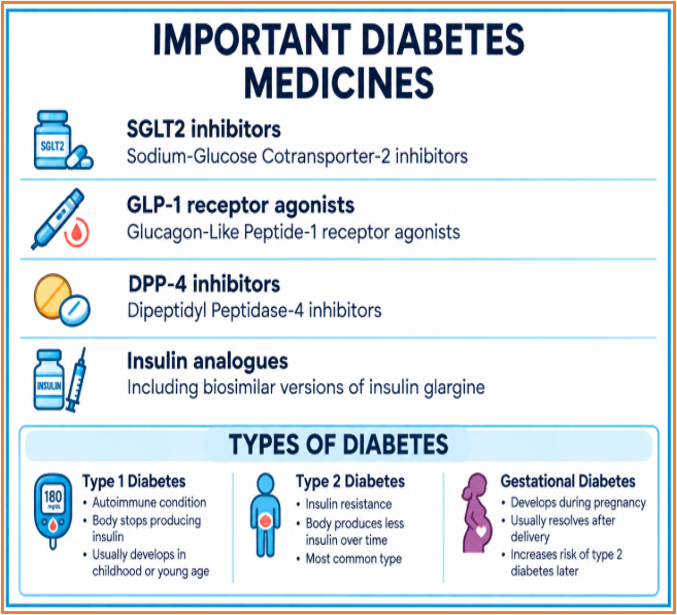
• Statement 2 is incorrect: While modern therapies like DPP-4 inhibitors, SGLT2i, and GLP-1 receptor agonists are approved and marketed in India, they are not currently included in the NLEM.
• Statement 3 is correct: Section 3(d) of the Indian Patents Act, 1970 prevents patent evergreening, ensuring that generic drug manufacturers can enter the domestic market once standard patents expire without facing artificial extensions.