
Context
- Recently, the World Economic Forum (WEF) released the 20th edition of the Global Gender Gap Report 2026, benchmarking gender parity across 145 economies, with India ranking 131st and closing 64.5% of its overall gender gap against the global average of 69.2%, while Iceland retained the highest position in the index.
What is the Global Gender Gap Index?
- The Global Gender Gap Index (GGGI) was introduced by the World Economic Forum in 2006 to measure the relative gaps between women and men across key areas of social and economic life.
- Scoring Methodology: Scores range from 0 to 1 (or 0% to 100%), where 1.0 represents full gender parity and 0 represents complete disparity.
- Key Principle: The index evaluates gender gaps in outcomes rather than the absolute level of available resources or overall development of a nation.
Global Rankings Overview (2026)
- Top Performers: Iceland maintained the 1st rank globally (the long-standing global leader), followed by Finland (2nd) and Norway (3rd).
- Bottom Performers: Chad was the lowest-ranked nation, joined by Iran and Pakistan in the bottom three slots.
- Countries Ranked Below India: 14 countries scored lower than India, including Papua New Guinea, Kuwait, Oman, Qatar, Tajikistan, Saudi Arabia, Egypt, Morocco, Mali, Algeria, and DR Congo.
India’s Performance
- India retained the 131st position with an overall gender parity score of 64.5%.
- Its score has improved by 4.3 percentage points since 2006, with much of the long-term improvement coming from Educational Attainment.
India’s Dimension-Wise Summary
| Dimension | Score | Key Takeaway |
| Political Empowerment | 24.5% | Highest rank (67th globally); Parliament (16.1%) and ministerial parity (5.9%) remain low. |
| Educational Attainment | 96.6% | Full parity in secondary and tertiary enrolment; adult literacy lags at 82.5%. |
| Health and Survival | 95.6% | Score improved, but sex ratio at birth remains below the 2006 baseline. |
| Economic Participation & Opportunity | 41.2% | Lowest-performing area; labour force parity stands at 44.1%. |
| Important CTC from this Article World Economic Forum (WEF) |
Q. Consider the following statements regarding the Global Gender Gap Index 2026:
1. It is released by the World Economic Forum.
2. It measures gender parity across four dimensions.
3. India recorded its highest score in Economic Participation and Opportunity in 2026.
4. The index measures the absolute level of development of women in an economy.
Which of the statements given above is/are correct?
(a) 1 and 2 only
(b) 1, 2 and 3 only
(c) 2 and 4 only
(d) 1, 2, 3 and 4
Answer: (a) 1 and 2 only
• Statement 1 is correct: The index is published by the World Economic Forum.
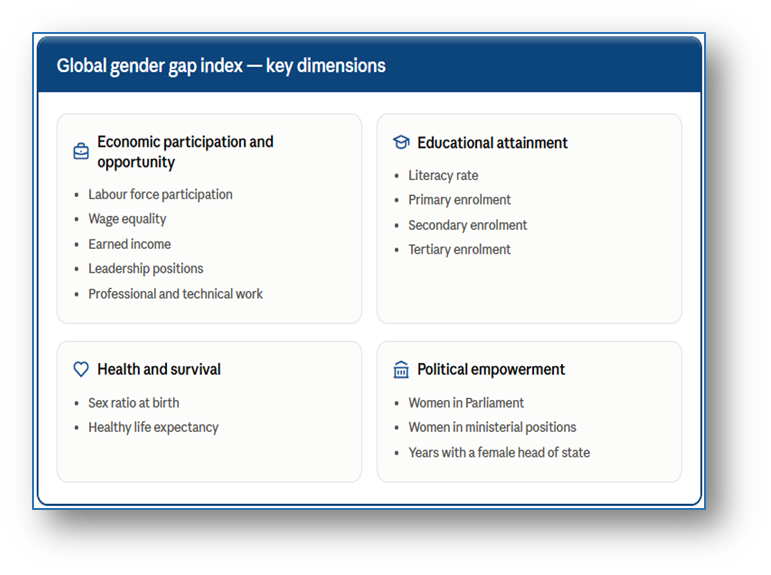
• Statement 2 is correct: It measures gender gaps across Economic Participation and Opportunity, Educational Attainment, Health and Survival, and Political Empowerment.
• Statement 3 is incorrect: India's strongest dimension in 2026 is Educational Attainment (96.6%), not Economic Participation and Opportunity.
• Statement 4 is incorrect: The index measures relative gender gaps/parity, not the absolute level of development of women.