
Context
- On the occasion of World Rhino Day (22nd September), the Prime Minister highlighted India’s efforts towards the conservation of the greater one-horned rhinoceros and announced the initiation of Project Rhino to strengthen species conservation.
About Project Rhino
- Project Rhino has been initiated to provide financial and technical support to the rhino range states for strengthening conservation efforts.
- The project focuses on rhino protection, habitat management, genetic improvement and understanding population dynamics.
- It aims to strengthen species conservation and active wildlife management across the rhino-bearing states.
Rhino Conservation in India
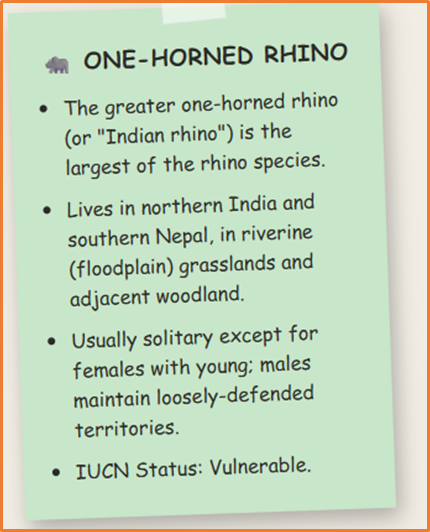
- Assam holds nearly 80% of the world’s rhino population, with Kaziranga National Park playing a major role in rhino conservation and anti-poaching efforts.
- Rhinos have either returned or are well protected in parts of Bihar and West Bengal.
- The successful reintroduction of rhinos in Dudhwa, Uttar Pradesh, represents an important conservation effort.
- The initiative highlights the importance of range-state cooperation, habitat management and scientific monitoring for long-term rhino conservation.
Some Key Interesting Facts
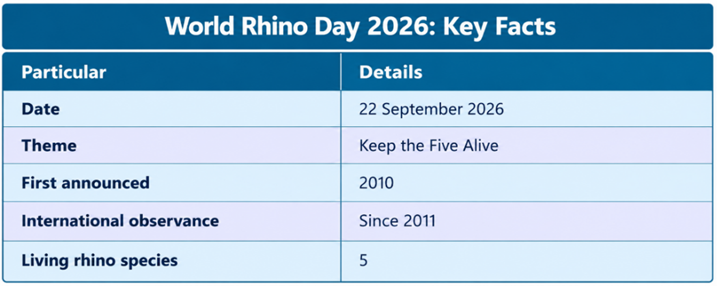
- There are five living rhino species worldwide—the Black, White, Sumatran, Javan and Greater One-Horned Rhinoceros. The Western Black Rhinoceros was declared extinct in 2011.
- Only white and black rhinos live in Africa, while the greater one-horned, Javan, and Sumatran rhinos live in Asia.
- Black rhinos are browsers, using their pointed upper lip to feed on leaves and twigs, while white rhinos are grazers, using their broad upper lip to feed mainly on grass.
- Not all rhinos have two horns; three rhino species—Black, White and Sumatran—have two horns, while the Greater One-Horned and Javan rhinos have one horn.
- Sumatran rhinos are the smallest of the living rhinoceroses.
- Rhino horns are made from keratin, just like human fingernails and hair.
- Rhinos have a slow reproductive rate, with a 15–18 months’ gestation period and typically one calf every 2–5 years.
Conclusion
Project Rhino represents a strengthened approach towards the conservation of the greater one-horned rhinoceros through financial support, scientific management, habitat protection and coordinated action among rhino range states.
| Important CTC From This Article – Greater One-Horned Rhinoceros |