
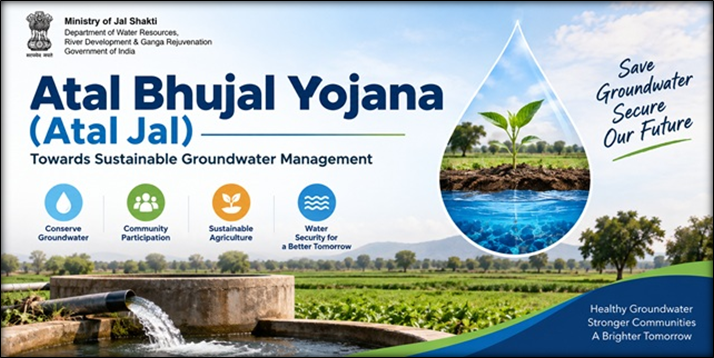
About Atal Bhujal Yojana
- Administrative Framework: Launched in 2019 as a Central Sector Scheme under the aegis of the Ministry of Jal Shakti.
- Operational Tenure: Originally mandated for a five-year period (2020–21 to 2024–25); officially extended by two years in May 2023 to ensure comprehensive implementation.
- Strategic Objective: To institutionalize sustainable, community-led management of groundwater resources across acutely water-stressed regions.
- Geographical Coverage: Targets 8,220 water-stressed Gram Panchayats across seven highly vulnerable states (Haryana, Gujarat, Karnataka, Madhya Pradesh, Maharashtra, Rajasthan, and Uttar Pradesh).
- Financial Architecture: Backed by a ₹6,000 crore corpus, financed through a 50:50 collaborative mechanism (a ₹3,000 crore loan from the World Bank matched by a ₹3,000 crore contribution from the Government of India).
Core Execution Components
- Institutional Strengthening & Capacity Building: Focuses on upgrading state-level groundwater monitoring networks and building administrative capacity by empowering decentralized Water User Associations (WUAs).
- Incentive Mechanism: Financially rewards states for achieving measurable improvements in groundwater governance, including the formulation of local water security plans, robust data dissemination, convergence of ongoing developmental schemes, and the adoption of demand-side management practices.
Key Deliverables
- Aims to establish a transparent, strengthened institutional framework for real-time groundwater data disclosure and optimize the localized planning and execution of hydrogeological interventions.
Conclusion
The Atal Bhujal Yojana represents a critical paradigm shift from unregulated groundwater extraction to community-led aquifer stewardship. By linking financial incentives directly to measurable conservation outcomes, the scheme is instrumental in ensuring long-term hydrological stability and agrarian resilience in India’s most water-stressed regions.
| This Concept Has Been Mentioned In This Article: Anatomy of India’s Groundwater Crisis and Agrarian Inequality |