
Context
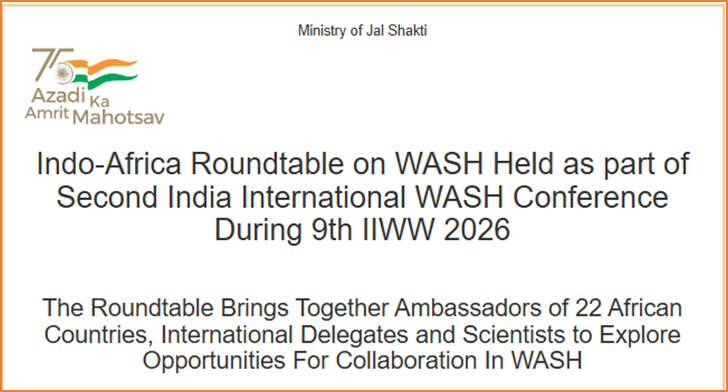
- The Indo-Africa Roundtable on Water, Sanitation and Hygiene (WASH) was held during the 9th India International Water Week (IIWW) 2026 to promote cooperation between India and African countries on water security, sanitation, digital innovation, community participation and climate-resilient WASH solutions.
Indo-Africa Roundtable on WASH
- Organised by the Department of Drinking Water and Sanitation (DDWS), Ministry of Jal Shakti.
- Held at Bharat Mandapam, New Delhi.
- Brought together representatives from 22 African countries, Indian officials, international organisations and development partners.
- Focused on knowledge exchange, capacity building and practical cooperation in WASH.
Key Lessons from India’s WASH Experience
- Focus on public health, dignity, women’s empowerment, community ownership and behavioural change.
- Strong political commitment and empowered local governments.
- Invest in people alongside infrastructure.
- Plan operation & maintenance (O&M) from the outset.
- Use simple, interoperable digital systems for accountability and service delivery.
Key Schemes & Missions
I. Jal Jeevan Mission (JJM)
- Objective: Provide Functional Household Tap Connections (FHTC) to every rural household (“Har Ghar Jal”).
- Nodal Ministry: Department of Drinking Water and Sanitation (DDWS), Ministry of Jal Shakti.
- Expanded coverage from 32.4 million rural households in 2019 to over 159.4 million households.
II. Sujalam Bharat
- Emerging Digital Public Infrastructure (DPI) for rural water governance.
- Enables source-to-tap visibility, digital asset mapping, data-driven governance and interoperable systems.
III. Swachh Bharat Mission-Gramin (SBM-G)
- Promotes sanitation through behavioural change and community participation.
- India achieved SDG Target 6.2 ahead of 2030.
IV. BISAG-N Integration
- Bhaskaracharya National Institute for Space Applications and Geo-informatics leverages GIS-based spatial mapping for monitoring water infrastructure assets.
Global & Institutional Frameworks
I. SWA (Sanitation and Water for All)
- It is a UN-hosted partnership focused on achieving universal access to water, sanitation, and hygiene, as outlined in Sustainable Development Goal 6 (SDG6).
- SWA brings together governments, utilities, donors, UN agencies, civil society and the private sector to reduce inequalities and empower vulnerable groups, especially women and girls.
II. Sustainable Development Goal 6 (SDG 6)
- Ensure availability and sustainable management of water and sanitation for all.
- Target 6.2: Access to adequate and equitable sanitation and hygiene for all.
Conclusion
India-Africa cooperation in WASH represents a shift from infrastructure-centric approaches towards community-led, digitally enabled and climate-resilient water and sanitation systems. Continued knowledge exchange, capacity building and South-South partnerships can support progress towards SDG 6 – Clean Water and Sanitation for All.
| Important CTC From this article- BISAG-N, SDG, Sanitation and Water for All |