
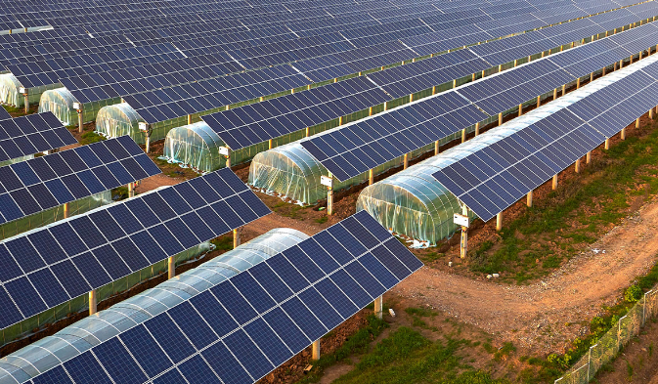
Agrivoltaics (Agri-PV) — What is it?
- Agrivoltaics, or Agri-PV, refers to the simultaneous use of the same land for agricultural production and solar photovoltaic electricity generation.
- Solar panels are installed above or alongside crops, allowing agricultural activity and renewable-energy generation to coexist.
How Does Agrivoltaics Work?
1. Dual Land Use:
Solar panels generate electricity while the land underneath or between them continues to support crop cultivation, grazing or other agricultural activities.
2. Microclimate Modification:
The partial shading provided by panels can reduce excessive solar radiation and soil moisture loss in suitable crops and climatic conditions.
3. Renewable-Energy Generation:
Photovoltaic panels convert sunlight into electricity, which may be used locally or supplied to the electricity grid.
4. Potential Additional Farm Income:
Farmers can potentially earn through electricity generation, leasing arrangements or participation in collective solar projects, depending on the project model.
Why is Agrivoltaics Important?
- Reduces the food–energy land-use trade-off by combining agriculture with renewable-energy generation.
- Can provide farmers with additional and diversified sources of income.
- May improve land-use efficiency where suitable crops and solar technologies are carefully matched.
- Supports India’s transition towards decentralised and renewable energy.
Related Concepts
- Agrivoltaics: Integration of agricultural activity and solar photovoltaic generation on the same land.
- Solar PV: Technology that converts sunlight directly into electricity using photovoltaic cells.
- Ground-mounted Solar: Solar panels installed on land primarily for electricity generation, generally without agricultural co-use.
Conclusion
Agrivoltaics represents a “food + energy” approach to land use, where renewable-energy generation can be integrated with agricultural activity rather than necessarily displacing it.
| This Concept has been discussed in the following article: Agri-PV in India: Linking Energy Transition with Farmer Incomes |