
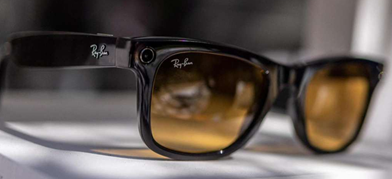
Context
Norway is considering temporary restrictions on the use of smart glasses in selected public and sensitive locations, highlighting concerns about privacy, surveillance, and the misuse of artificial intelligence (AI).
Major Privacy and Security Concerns
- Covert recording: Unlike smartphones, smart glasses can record images and audio discreetly, making it difficult for bystanders to know when they are being recorded.
- Lack of informed consent: Individuals may be recorded without their knowledge, particularly in sensitive environments.
- Risks to children: Unauthorised filming in schools and other child-focused spaces raises safety concerns.
- AI-enabled surveillance: Facial recognition may allow the identification of strangers and facilitate unauthorised profiling or doxxing.
- Limitations of existing laws: Traditional privacy frameworks may not adequately address continuous, hands-free and ambient recording.
Regulatory Responses in Other Countries
| Country/Region | Regulatory response |
| Netherlands and Belgium | Hans Anders suspended sales of Meta’s Ray-Ban smart glasses in its Dutch and Belgian stores pending regulatory clarity. |
| Germany | Hamburg is exploring regional restrictions on smart glasses. |
| United Kingdom | Cinema-sector guidelines restrict or prohibit camera-equipped glasses in theatres; courts in England and Wales require visitors to surrender them at security checkpoints. |
| United States | Some nightclubs, gyms and courts have introduced localised restrictions. |
| Thailand | Smart glasses use is restricted in certain pubs and public places, according to the provided article. |
About Smart Glasses
- Smart glasses are wearable computing devices integrated into eyewear, offering features such as cameras, microphones, speakers, wireless connectivity and AI assistance.
- Some smart glasses overlay digital information onto the user’s view of the physical world. Not all smart glasses have AR displays.
- Key Technologies: They may use computer vision, natural language processing, Bluetooth, Wi-Fi, GPS and motion sensors, depending on the model.
- Technological Safeguards: Some devices use recording-indicator LEDs, camera-disabling mechanisms and recording notifications. However, these cannot guarantee complete privacy protection.
Smart Glasses vs AR Glasses vs VR Headsets
| Feature | Smart Glasses | AR Glasses | VR Headsets |
| Core function | Capture and assist (camera, audio, AI) | Overlay digital content on the real world | Replace the real world with a virtual one |
| Real-world view | Fully visible | Visible, with digital overlay | Blocked |
| Display | Minimal or none | Transparent display | Fully enclosed display |
| Immersion level | Low | Medium | High |
| Form factor | Looks like normal spectacles | Bulkier glasses | Bulky, enclosed headset |
| Use in public | Common | Limited | Mostly indoors, at home |
| Examples | Ray-Ban Meta | HoloLens, Magic Leap | Meta Quest, HTC Vive |
| Main uses | Hands-free recording, calls, AI assistant | Training, navigation, industrial and medical use | Gaming, simulation, virtual training |
| Privacy concern | High (covert recording, facial recognition) | Moderate (cameras and spatial mapping) | Lower (but collects biometric and motion data) |
Q. Consider the following statements regarding smart glasses and the emerging regulatory challenges associated with wearable technology:

1. Unlike traditional smartphones, camera-equipped smart glasses capture video and ambient audio from eye level without offering conspicuous physical cues to bystanders, raising concerns regarding covert surveillance.
2. Norway’s proposed regulatory framework recommends a complete, nationwide ban on the manufacturing and retail sale of all wearable smart devices.
3. Current-generation smart glasses incorporate physical safeguards such as LED indicator lights that illuminate during recording, with firmware designed to disable the device if the LED is deliberately obstructed.
4. The integration of smart glasses with real-time facial recognition software poses significant risks regarding unauthorized identification and doxxing in public spaces.

Which of the statements given above are correct?
(a) 1, 2 and 3 only
(b) 1, 3 and 4 only
(c) 2 and 4 only
(d) 1, 2, 3 and 4

Correct Answer: (b) 1, 3 and 4 only

Explanation:
• Statement 1 is correct: Traditional smartphones require users to hold up the device visibly to record video, giving surrounding individuals a clear signal. In contrast, smart glasses allow wearers to capture high-resolution imagery and audio directly at eye level without obvious behavioral cues.
• Statement 2 is incorrect: Norway’s proposal does not ban the commercial sale of smart glasses or their use in private spaces. Instead, it suggests temporary restrictions on usage in sensitive public spaces (such as schools, healthcare facilities, and fitness centers) alongside expert evaluations to formulate lasting legal frameworks.
• Statement 3 is correct: Current devices (such as Ray-Ban Meta smart glasses) feature a white LED that blinks during photo capture and stays lit during video recording, with firmware updates programmed to automatically disable functionality if the LED indicator is covered or obstructed.
• Statement 4 is correct: Combining wearable cameras with real-time facial recognition software creates severe privacy risks, potentially allowing wearers to instantly identify strangers, access private databases, or facilitate doxxing.