
Context
- India hosted the first-ever meeting of Home Ministers of BIMSTEC member countries, which adopted the Delhi Declaration to strengthen regional cooperation against terrorism and violent extremism.
About BIMSTEC
- Full Name: Bay of Bengal Initiative for Multi-Sectoral Technical and Economic Cooperation.
- Established: 1997 through the Bangkok Declaration.
- Secretariat: Dhaka, Bangladesh.
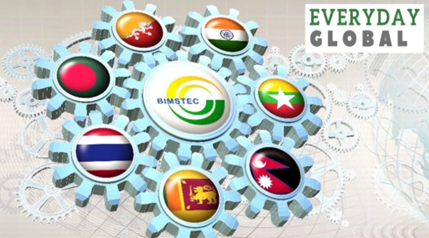
- Member Countries: Seven members; Bangladesh, Bhutan, India, Myanmar, Nepal, Sri Lanka and Thailand.
- Key Areas of Cooperation: Trade, investment, connectivity, security, energy, technology and people-to-people exchanges.
Key Highlights of the Delhi Declaration
- Counter-Terrorism Cooperation: Condemns terrorism and violent extremism in all forms, including cross-border terrorism, and calls for sustained regional efforts to combat these threats.
- Prevention of Radicalisation: Emphasises measures to counter radicalisation and violent extremism conducive to terrorism.
- Countering Terror Financing: Calls for adherence to internationally agreed anti-money laundering and counter-terror financing standards, consistent with domestic and international law.
- Misuse of Emerging Technologies: Highlights the need to prevent terrorist exploitation of encrypted communications, social media, drones, cryptocurrencies and the dark web.
- Implementation of UN Sanctions: Calls for effective implementation of relevant UN Security Council sanctions measures, including those of the 1267 Sanctions Committee.
- Justice for Victims: Expresses solidarity with victims of terrorist attacks and their families and calls for those responsible to be brought to justice in accordance with applicable laws.
Five Key Areas of Cooperation Highlighted by India
- Drug Control: Strengthening cooperation against illicit drug trafficking and narco-trade.
- Counter-Terrorism and Legal Cooperation: Improving coordination to investigate and combat terrorism and transnational crime.
- Repatriation of Fugitive Criminals: Enhancing cooperation in the extradition and repatriation of criminals operating across national borders, in accordance with applicable legal frameworks.
- Cybersecurity and Cybercrime Investigations: Strengthening cooperation to address cybercrime, cyber slavery and the misuse of digital technologies.
- Institutional Cooperation and Capacity Building: Improving coordination among law enforcement agencies, intelligence services and border management authorities.
With reference to BIMSTEC and the Delhi Declaration, consider the following statements:
- BIMSTEC was established in 1997 through the Bangkok Declaration.
- The BIMSTEC Secretariat is located in Dhaka, Bangladesh.
- The Delhi Declaration calls for cooperation against terrorism, violent extremism and terrorist financing.
- BIMSTEC comprises seven member countries, including Pakistan and the Maldives.
Which of the statements given above are correct?
(a) 1 and 2 only (b) 1, 2 and 3 only (c) 2, 3 and 4 only (d) 1, 2, 3 and 4
Answer: (b) 1, 2 and 3 only
Statement 1 is correct. BIMSTEC was formed on 6 June 1997 through the Bangkok Declaration, initially as BIST-EC (Bangladesh, India, Sri Lanka, Thailand Economic Cooperation).
Statement 2 is correct. The permanent Secretariat is in Dhaka, Bangladesh, and became operational in 2014.
Statement 3 is plausibly correct, but I couldn’t confirm it. My search turned up nothing on a “Delhi Declaration” by name. The closest results were the 2018 Kathmandu Declaration, which called for a comprehensive counter-terror approach including preventing terrorist financing and countering radicalisation. Counter-terrorism language is a standard feature of BIMSTEC outcome documents, so the statement fits the pattern. Please check it against your source for the Delhi Declaration.
Q. With reference to BIMSTEC and the Delhi Declaration, consider the following statements:
1.	BIMSTEC was established in 1997 through the Bangkok Declaration.
2.	The BIMSTEC Secretariat is located in Dhaka, Bangladesh.
3.	The Delhi Declaration calls for cooperation against terrorism, violent extremism and terrorist financing.
4.	BIMSTEC comprises seven member countries, including Pakistan and the Maldives.

Which of the statements given above are correct?
(a) 1 and 2 only (b) 1, 2 and 3 only (c) 2, 3 and 4 only (d) 1, 2, 3 and 4
Answer: (b) 1, 2 and 3 only
Statement 1 is correct. BIMSTEC was formed on 6 June 1997 through the Bangkok Declaration, initially as BIST-EC (Bangladesh, India, Sri Lanka, Thailand Economic Cooperation).

Statement 2 is correct. The permanent Secretariat is in Dhaka, Bangladesh, and became operational in 2014.
Statement 3 is plausibly correct, but I couldn’t confirm it. My search turned up nothing on a “Delhi Declaration” by name. The closest results were the 2018 Kathmandu Declaration, which called for a comprehensive counter-terror approach including preventing terrorist financing and countering radicalisation. Counter-terrorism language is a standard feature of BIMSTEC outcome documents, so the statement fits the pattern. Please check it against your source for the Delhi Declaration.
Statement 4 is incorrect. BIMSTEC has seven members: Bangladesh, Bhutan, India, Myanmar, Nepal, Sri Lanka and Thailand. Pakistan and the Maldives are not members. This is the classic trap, because both are South Asian states, so they sound like plausible members.