
Context
- Recent, studies across India have detected Per- and Polyfluoroalkyl Substances (PFAS) in groundwater, surface water, sewage and coastal waters, raising concerns about environmental contamination and potential health risks.
About PFAS
- Full Form: Per- and Polyfluoroalkyl Substances.
- Nature: A large group of synthetic chemicals characterised by multiple carbon–fluorine bonds.
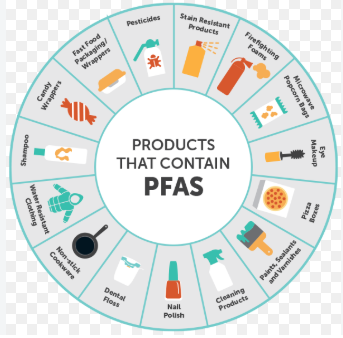
- Common Uses: Coatings, textiles and various industrial and consumer products.
- Key Property: Strong carbon–fluorine bonds make many PFAS highly resistant to environmental degradation.
- Persistence: Many PFAS persist in the environment for long periods and are commonly referred to as “forever chemicals.”
- Environmental Occurrence: Found in water, soil, sewage and other environmental matrices.
- Major Concern: Their persistence, potential toxicity and widespread use make them a significant emerging environmental concern.
Sources and Pathways of PFAS Contamination
- Industrial Discharges: Release of PFAS-containing chemicals through industrial wastewater.
- Municipal Sewage: Domestic wastewater can carry PFAS from consumer products and other sources.
- Landfills and Garbage Dumps: Leaching from discarded products can contaminate groundwater.
- Consumer Products: PFAS-containing coatings, textiles and other materials can contribute to environmental releases.
- Transformation of Precursors: Certain precursor compounds can transform into more persistent PFAS in the environment or during treatment processes.
Environmental and Health Implications
- Environmental Persistence: Many PFAS resist natural degradation, allowing contamination to persist over extended periods.
- Potential Human Health Risks: Health risks depend on the specific compound, exposure dose, duration and route of exposure.
- Carcinogenicity: According to the International Agency for Research on Cancer (IARC), in its 2025 monograph:
- PFOA (Perfluorooctanoic acid): Classified as carcinogenic to humans (Group 1).
- PFOS (Perfluorooctanesulfonic acid): Classified as possibly carcinogenic to humans (Group 2B).
- Aquatic Toxicity: A 2026 study examining a mixture of 24 PFAS compounds reported delayed hatching, reduced growth, accumulation in zebrafish blood and reduced heart rates in offspring.
- Food-Chain Concerns: Certain PFAS can accumulate in organisms and may enter food chains, depending on their chemical properties and environmental conditions.
India’s Regulatory and Institutional Response
- Bureau of Indian Standards (BIS): The drinking-water standard IS 10500:2012 is under revision. A dedicated Working Group on Emerging Contaminants and Forever Chemicals is examining PFAS limits and associated contaminants.
- Ministry of Environment, Forest and Climate Change: The Ministry has stated that there is no specific regulation banning PFAS manufacturing.
- CSIR–Indian Institute of Toxicology Research (CSIR-IITR): Participating in a UNEP-funded National Implementation Plan to build baseline data on PFAS in environmental matrices and consumer products.
- Analytical Capacity: CSIR-IITR has developed capabilities to detect 50 multi-class PFAS molecules across different environmental and product matrices.
Q. With reference to Per- and Polyfluoroalkyl Substances (PFAS), consider the following statements:
1.	PFAS are often called “forever chemicals” because many of them resist environmental degradation.
2.	The International Agency for Research on Cancer (IARC) has classified PFOA as carcinogenic to humans and PFOS as possibly carcinogenic to humans.
3.	India has a specific regulation that completely bans the manufacture of all PFAS.
4.	PFAS contamination can occur through industrial discharges, municipal sewage and leaching from landfills.
Which of the statements given above are correct?
(a) 1 and 2 only
(b) 1, 2 and 4 only
(c) 2, 3 and 4 only
(d) 1, 2, 3 and 4
Answer: (b) 1, 2 and 4 only
Statement 1 is correct. PFAS have very strong carbon-fluorine bonds, so many of them resist breakdown by heat, water, light and biological processes. They persist and bioaccumulate in the environment and in living organisms, which is why they are called “forever chemicals.”
Statement 2 is correct. In 2023, IARC classified PFOA in Group 1 (carcinogenic to humans) and PFOS in Group 2B (possibly carcinogenic to humans).
Statement 3 is incorrect. India has no regulation that completely bans the manufacture of all PFAS. PFOS, PFOA and PFHxS are covered under the Stockholm Convention, which India has ratified, and India regulates some of them under its Persistent Organic Pollutants rules. That is not a blanket ban on the whole class of thousands of PFAS. Words like “specific,” “completely” and “all” are the usual signal of a wrong statement in UPSC questions.
Statement 4 is correct. PFAS enter the environment through industrial discharges (fluoropolymer manufacturing, textiles, firefighting foam), municipal sewage and sludge, and landfill leachate, and can then contaminate groundwater and drinking water.