
Context
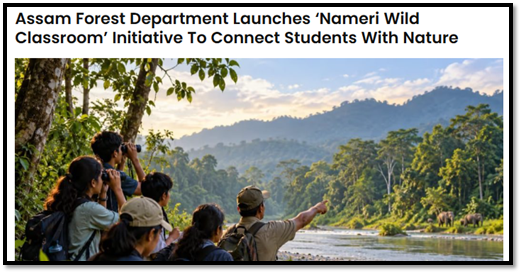
- The Assam Forest Department has launched the ‘Nameri Wild Classroom’ initiative to promote experiential environmental education by connecting students directly with nature at Nameri Tiger Reserve, Assam.
About Nameri Wild Classroom
- Launched by: Assam Forest Department.
- Location: Nameri Tiger Reserve, Assam.
- Target group: Students of Class 8 and above, including college students.
- Guidance: Naturalists and forest personnel.
- Nature: Experiential and field-based environmental education.
- Key focus: Wildlife conservation, biodiversity, river ecology and traditional knowledge of local communities.
Key Features of the Initiative
- Experiential Learning: Enables students to understand forest ecosystems through direct observation and field-based activities rather than relying solely on textbook learning.
- Wildlife and Biodiversity Education: Includes birdwatching, guided forest walks and wildlife tracking to familiarise students with local flora and fauna.
- River Ecology: Provides opportunities to learn about river ecosystems and experience rafting on the Jia-Bharali River.
- Traditional Ecological Knowledge: Introduces students to the traditions and knowledge of local communities associated with the surrounding landscape.
- Field Journals and Certification: Participants maintain field journals to record observations and receive certificates upon completion of the programme.
- Career Awareness: May encourage students to explore careers in wildlife research, ecology, environmental science and conservation.
About Nameri Tiger Reserve
- Location: Foothills of the Eastern Himalayas in Assam, in the Sonitpur district region.
- River system: The Jia-Bharali River and its tributaries form an important part of the surrounding landscape.
- Ecological significance: Known for its rich biodiversity, forest ecosystems and importance as wildlife habitat.
- Protected-area status: Nameri is a tiger reserve under India’s Project Tiger framework.
Conclusion
The Nameri Wild Classroom initiative demonstrates how experiential learning can complement formal education by connecting students with forest and river ecosystems. By integrating biodiversity education, scientific observation and local ecological knowledge, it can help nurture a generation committed to wildlife conservation and environmental responsibility.