
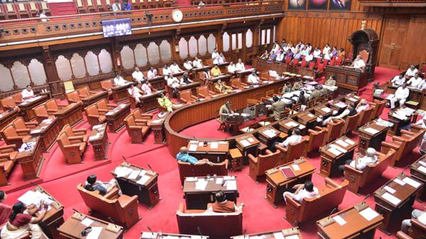
Context
Recently, elections to the State Legislative Councils (MLCs) in four major states—Uttar Pradesh, Maharashtra, Bihar, and Karnataka—were conducted using ballot papers rather than EVMs, bringing the constitutional role, structure, and political relevance of State Legislative Councils back into the national spotlight.
About State Legislative Councils
- A State Legislative Council (Vidhan Parishad) is the Upper House of the State Legislature.
- India follows a bicameral legislature in some states, consisting of:
- Legislative Assembly (Vidhan Sabha): Lower House.
- Legislative Council (Vidhan Parishad): Upper House.
- Under Article 168, the State Legislature may consist of the Governor and one or two Houses, depending on the state.
- The Legislative Council is a permanent body and is not subject to dissolution.
Constitutional Provisions
- Article 169: Enables Parliament to create or abolish a State Legislative Council following a resolution passed by the State Legislative Assembly with a special majority. Parliament can then enact the law by a simple majority.
- Article 171: Specifies the composition of the Legislative Council. Its total membership cannot exceed one-third of the State Legislative Assembly’s strength and must generally be at least 40 members.
- Articles 172(2) and 173: Article 172(2) provides for the Legislative Council as a permanent body that cannot be dissolved, with one-third of its members retiring every two years. Article 173 prescribes the eligibility requirements, including a minimum age of 30 years for membership.
Election and Nomination of Members
- Strength Limits: The total number of members in the Legislative Council cannot exceed one-third of the total strength of the State Assembly, but it must have a minimum of 40 members.
- Indirect Elections: Members are indirectly elected or nominated:
- 1/3rd elected by local authorities (municipalities, district boards).
- 1/3rd elected by members of the Legislative Assembly (from non-members).
- 1/12th elected by graduates of three years’ standing residing in the state.
- 1/12th elected by teachers (secondary school or above) with at least three years of experience.
- Nomination: The remaining 1/6th are nominated by the Governor for special knowledge in literature, science, art, cooperative movement, or social service.
Legislative Council vs Legislative Assembly
| Basis | Legislative Council | Legislative Assembly |
| Position | Upper House | Lower House |
| Nature | Permanent | Subject to dissolution |
| Minimum age | 30 years | 25 years |
| Election | Mostly indirect | Direct election |
| Money Bills | Cannot introduce Money Bills | Can introduce Money Bills |
| Role in Money Bills | Can only make recommendations within 14 days | Has the final say |
| Ordinary Bills | Can delay but cannot permanently block a Bill | Has a stronger legislative position |
| Abolition | Can be abolished under Article 169 | Cannot be abolished while retaining a State Legislature |
| Important CTC from this Article: Money bill |
Q. Consider the following statements regarding the State Legislative Council in India:

I. Parliament can create or abolish a State Legislative Council only if the concerned State Legislative Assembly passes a resolution to that effect by a simple majority.
II. The total number of members in a Legislative Council can be up to half the total strength of the respective State Legislative Assembly.
III. The Governor nominates one-sixth of the members of the Legislative Council from persons having special knowledge in literature, science, art, cooperative movement, or social service.

Which of the statements given above is/are correct?

(a) I and II only
(b) III only
(c) II and III only
(d) I, II and III

Answer: (b)

Explanation:
• Statement I is incorrect: Under Article 169, while Parliament passes the final law by a simple majority, the concerned State Legislative Assembly must first pass the resolution by a special majority, not a simple majority.
• Statement II is incorrect: Under Article 171, the total strength of the Legislative Council cannot exceed one-third (not half) of the total strength of the State Legislative Assembly (with a minimum of 40 members)
• Statement III is correct: The Governor nominates exactly one-sixth of the members of the Council. Unlike the President's nominations to the Rajya Sabha, the Governor's nominations include expertise in the "cooperative movement."