
Context
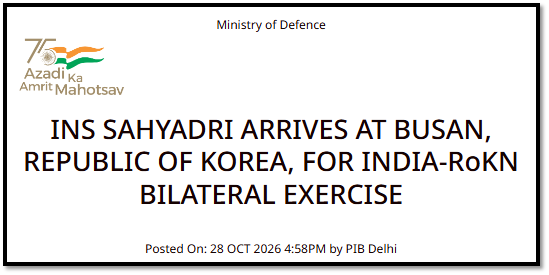
INS Sahyadri arrived at Busan Naval Harbour, Republic of Korea, on to participate in the India–Republic of Korea Navy (IN–RoKN) Bilateral Exercise.
About INS Sahyadri
- NS Sahyadri (F49) is an indigenously designed and built Shivalik-class guided-missile stealth frigate of the Indian Navy.
- Built by: Mazagon Dock Shipbuilders Limited (MDL), Mumbai.
- Commissioned: 21 July 2012.
- Class: Shivalik-class (Project 17).
- Design: Developed with the involvement of the Indian Navy’s Directorate of Naval Design.
- Key Features:
- Incorporates stealth technology to reduce its radar signature.
- Equipped for anti-aircraft, anti-surface and anti-submarine warfare.
- Features advanced sensors, weapons systems and electronic warfare capabilities.
Key Highlights of the India–Republic of Korea Naval Exercise
1. Harbour Phase
- Personnel from both navies will participate in:
- Professional interactions and cross-deck visits.
- Cross-training activities and sporting events.
- Exchange of operational experiences and best practices.
- These activities promote mutual understanding, professional camaraderie and cooperation between the two navies.
2. Maritime Phase
- The harbour phase will be followed by coordinated maritime activities at sea involving:
- INS Sahyadri: Indian Navy.
- ROKS Munmu the Great: Republic of Korea Navy.
- The activities aim to enhance operational coordination and interoperability between the participating naval forces.
Significance of the Exercise
- Strengthening Bilateral Relations: Reinforces the strategic partnership between India and the Republic of Korea through defence engagement and professional cooperation.
- Enhancing Maritime Security: Promotes cooperation between the two navies in maintaining peace, stability and security in the Indo-Pacific.
- Improving Interoperability: Joint maritime activities and cross-training enable both navies to coordinate more effectively during operational deployments.
- Promoting Indigenous Defence Capabilities: The participation of INS Sahyadri highlights India’s indigenous warship-design and shipbuilding capabilities.
- Strengthening India’s Indo-Pacific Engagement: Supports India’s efforts to build enduring partnerships with friendly countries and promote a free, open, peaceful and stable Indo-Pacific.
Conclusion
The India–Republic of Korea bilateral naval exercise reflects the growing maritime partnership between the two countries. Through professional exchanges and coordinated maritime operations, the exercise strengthens naval interoperability, enhances mutual trust and contributes to regional peace and stability in the Indo-Pacific.
| Important CTC from this Article: INS Sahyadri |