
Context
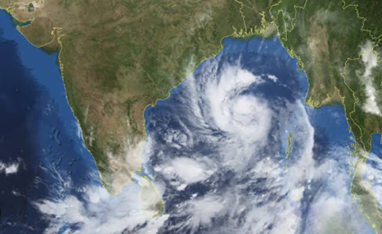
A recent report highlighted how El Niño influenced the path and intensity of Cyclone Arnab, which affected parts of the eastern coast of India.
About El Niño
- El Niño is the periodic warming of sea-surface temperatures in the central and eastern equatorial Pacific Ocean.
- It is the warm phase of the El Niño–Southern Oscillation (ENSO), a climate pattern involving interactions between the ocean and atmosphere.
- It can influence global atmospheric circulation, rainfall patterns, monsoons and tropical cyclone activity.
How El Niño Can Influence Tropical Cyclones?
- Atmospheric circulation: El Niño changes large-scale atmospheric circulation, potentially influencing the environmental conditions in which cyclones develop.
- Vertical wind shear: It can alter vertical wind shear—the change in wind speed or direction with altitude—which may affect cyclone formation and intensification.
- Regional differences: El Niño’s effects vary across ocean basins. Its influence on cyclone activity in the North Indian Ocean is complex and is not uniform in every event.
- Cyclone track and intensity: Cyclone movement and strength also depend on sea-surface temperatures, atmospheric pressure systems, steering winds and other local conditions.
Tropical Cyclones’ Fuel
- Niño 3.4 region: Used to measure El Niño’s intensity. Sea surface temperature here was 2-2.8°C above normal in July-September 2026.
- Condition for formation: Ocean temperature of 26°C or above at depths of 50-100 m.
- Warm oceans can cause rapid intensification at sea.
- Other factors: Boundary layers, wind shear, convection, upper ocean circulation, air-sea interaction.
How Are Cyclones Named?
- Naming in the Bay of Bengal and Arabian Sea began in September 2004, following a 2000 meeting of an intergovernmental panel (the WMO/ESCAP Panel on Tropical Cyclones).
- Members: Initially 8 countries (Bangladesh, India, Maldives, Myanmar, Oman, Pakistan, Sri Lanka, Thailand). In 2018, 5 more joined (Iran, Qatar, Saudi Arabia, UAE, Yemen), making 13.
- Rules: Names must be short, easy to pronounce and inoffensive. A name, once used, is never repeated.
- Who names: The Regional Specialised Meteorological Centre (RSMC), New Delhi, assigns the name once a system reaches 62 kmph.
- Order: Countries are listed alphabetically and their names used in sequence. When all 13 names in a column are used, the next column is taken.
- Arnab (pronounced “Ornab”) was proposed by Bangladesh. The next name is Murasu, proposed by India (a Tamil word for drum).
Q. With reference to cyclones in the North Indian Ocean, consider the following statements:

1. During El Niño years, cyclones forming in the Bay of Bengal tend to form at lower latitudes and are more likely to affect the Andhra Pradesh and Tamil Nadu coasts.
2. Cyclone names for the Bay of Bengal and Arabian Sea are officially assigned by the Regional Specialised Meteorological Centre, New Delhi, once a weather system reaches 62 kmph.
3. The Niño 3.4 region, used to measure the intensity of El Niño, lies in the equatorial Atlantic Ocean.
4. Once the names suggested by all 13 member countries are used, the list is repeated from the beginning.

Which of the statements given above is/are correct?

(a) 1 and 2 only
(b) 2 and 3 only
(c) 1, 2 and 4
(d) 1, 3 and 4

Answer: (a)

Explanation:
Statement 1 is correct: in El Niño years, cyclones form along lower latitudes and are more likely to move towards Andhra Pradesh and Tamil Nadu than Odisha and West Bengal.
Statement 2 is correct: RSMC New Delhi assigns the name once the system crosses the 62 kmph threshold for a cyclone.
Statement 3 is incorrect: the Niño 3.4 region lies in the equatorial Pacific Ocean, not the Atlantic.
Statement 4 is incorrect: after all 13 names in a column are used, the next column of the list is taken, and a cyclone name is never repeated.