
Context
Recently, scientists from the United Kingdom and Japan identified the role of an unconventional myosin gene in determining the left- or right-handed shell coiling in Japanese Euhadra snails.
About Shell Handedness in Snails
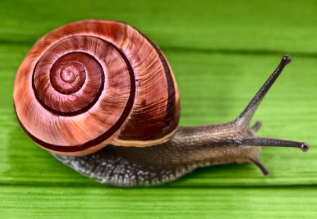
- Meaning: Shell handedness refers to the direction in which a snail’s shell coils.
- Types:
- Dextral (Right-handed): The shell coils towards the right.
- Sinistral (Left-handed): The shell coils towards the left.
- Most Euhadra snail species are right-handed, while only four species are predominantly left-handed.
- Opposite-handed snails face difficulties during mating because their reproductive openings are positioned asymmetrically, making successful mating difficult.
Genetic Basis of Shell Handedness
- Responsible Gene: An unconventional myosin gene plays a key role in determining shell coiling direction.
- Researchers identified two variants of this gene:
- S Variant (Sinistral): Associated with left-handed shell coiling.
- D Variant (Dextral): Associated with right-handed shell coiling.
Role of Maternal Effect
- Snail handedness is determined by the mother’s genotype, not directly by the offspring’s own genotype.
- This is known as the maternal effect, in which the mother’s genetic makeup influences the development of her offspring.
- The determination occurs at a very early embryonic stage, before the offspring’s own genes begin to express themselves.
About Myosin Protein
- Myosin is a motor protein that interacts with actin filaments to generate mechanical force and movement within cells.
- It plays an important role in:
- Muscle contraction and body movement.
- Cell division.
- Cell movement and intracellular transport.
- Different variants of myosin may influence the direction of actin filament movement, contributing to cellular asymmetry.
Reproductive Characteristics of Snails
- Hermaphrodites: Snails possess both male and female reproductive organs and can produce sperm and eggs.
- Genital Pore: The reproductive opening is generally located close to the head, on the right side of the body.
- Mating: During mating, two snails exchange sperm through their reproductive organs.
Significance of the Discovery
- Explains how genetic variations can influence left-right asymmetry during embryonic development.
- Provides insights into the relationship between molecular mechanisms and whole-body structural organisation.
- Helps understand the role of motor proteins in cellular development and evolutionary biology.
- Establishes snails as an important model for studying the origin of biological asymmetry.
| Important CTC From This Article: Myosin |
Q. With reference to shell handedness in snails, consider the following statements:

1. The direction of shell coiling in Euhadra snails is determined exclusively by the offspring's own genetic makeup.
2. The S variant of the myosin gene is associated with left-handed shell coiling.
3. Myosin interacts with actin filaments and plays a role in generating mechanical force within cells.
4. Snails are generally hermaphrodites, possessing both male and female reproductive organs.

Which of the statements given above are correct?

(a) 1 and 2 only
(b) 2, 3 and 4 only
(c) 1, 3 and 4 only
(d) 1, 2, 3 and 4

Answer: (b) 2, 3 and 4 only

Explanation:
Statement 1 is incorrect: Shell handedness in Euhadra snails is determined by the mother's genotype rather than directly by the offspring's own genotype. This phenomenon is known as the maternal effect.
Statement 2 is correct: Researchers identified two variants of the myosin gene. The S (sinistral) variant is associated with left-handed shell coiling, while the D (dextral) variant is associated with right-handed shell coiling.
Statement 3 is correct: Myosin is a motor protein that interacts with actin filaments to generate mechanical force. It plays important roles in muscle contraction, cell movement and cell division.
Statement 4 is correct: Snails are generally hermaphrodites, meaning that an individual possesses both male and female reproductive organs and can produce sperm and eggs.