
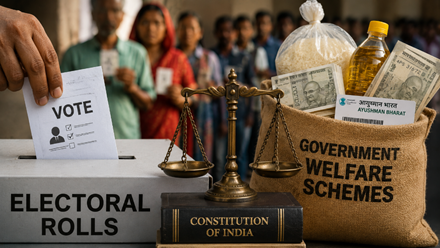
After Reading This Article You Can Solve This UPSC Mains Model Question:
The use of electoral rolls for identifying welfare beneficiaries risks converting electoral exclusion into socio-economic exclusion. Examine the constitutional, institutional and governance-related concerns associated with this approach. Suggest measures to ensure inclusive welfare delivery. 15 Marks (GS 2, Governance)
Context
Union Minister Singh proposed using Voter ID (EPIC) with biometric authentication instead of Aadhaar for identifying welfare beneficiaries.
Introduction
Electoral rolls determine the right to vote, while welfare databases identify beneficiaries based on scheme-specific eligibility. Using electoral identity as a basis for welfare delivery risks conflating two distinct constitutional and administrative purposes.
Understanding the Core Issue
Electoral Roll vs Welfare Beneficiary Identification
| Electoral Roll | Welfare Beneficiary Database |
| Determines eligibility to vote. | Determines eligibility for social protection. |
| Governed by electoral laws. | Governed by scheme-specific laws and guidelines. |
| Based on electoral registration criteria, including ordinary residence and age. | Based on socio-economic conditions and eligibility criteria of individual schemes. |
| Exclusion affects electoral participation. | Exclusion can deprive individuals of essential services and entitlements. |
Constitutional and Legal Framework
A. Supreme Court’s observations on SIR (May 27 judgment)
The Supreme Court clarified important limitations on the ECI’s powers:
- The ECI can undertake only a limited enquiry into citizenship for determining eligibility for inclusion in electoral rolls.
- Any action arising from such an exercise must remain confined to electoral consequences.
- Deletion from electoral rolls affects an individual’s place on the roll and the corresponding right to vote, not their independent welfare entitlements.
- EPIC is a derivative document, issued on the basis of inclusion in the electoral roll. Using it to verify the correctness of that very roll would create a logical contradiction.
B. Relevant Constitutional Provisions
| Constitutional provision | Relevance |
| Article 14 | Equality before law; arbitrary exclusion from welfare benefits violates the principle of non-arbitrariness. |
| Article 21 | Right to life with dignity; access to essential welfare services is closely linked to dignified existence. |
| Article 38 | Directs the State to promote social, economic and political justice. |
| Article 39(b) | Ensures distribution of material resources to serve the common good. |
| Article 41 | Provides for the State’s obligation to secure public assistance within its economic capacity. |
| Article 47 | Makes improvement of nutrition and public health among the State’s primary duties. |
| Article 326 | Provides for adult suffrage; electoral eligibility is distinct from welfare eligibility. |
C. Relevant Legal Framework
- Representation of the People Act, 1950: Governs preparation and revision of electoral rolls.
- Aadhaar Act, 2016: Provides the statutory framework for Aadhaar-based identity authentication, subject to applicable legal safeguards.
- National Food Security Act, 2013: Establishes statutory food security entitlements for eligible households.
Major Challenges and Concerns
1. Arbitrary exclusion from welfare entitlements
- Linking welfare delivery to electoral rolls can deprive individuals of essential services due to wrongful deletion or errors in electoral registration.
- It creates a situation where electoral disenfranchisement can translate into socio-economic exclusion.
2. Flaws in the Special Intensive Revision (SIR)
- Stringent residency requirements and documentation-related difficulties can disproportionately affect migrant workers, itinerant populations and vulnerable communities.
- In West Bengal, nearly 93% of appeals against deletion resulted in restoration of names by September 2026, indicating substantial wrongful exclusions.
3. Violation of the principle of universal social protection
- Welfare eligibility should be determined by socio-economic vulnerability and scheme-specific criteria rather than electoral registration.
- Linking benefits to voter identity risks excluding children, non-voters and other vulnerable individuals who may otherwise qualify for assistance.
4. Constitutional and institutional overreach
- The ECI’s mandate is to conduct free and fair elections, not determine access to welfare schemes.
- Using electoral rolls for welfare verification risks expanding the consequences of electoral decisions beyond their constitutional purpose.
5. Weakening of the welfare state
- Welfare programmes are instruments of distributive justice and social protection.
- Making benefits conditional upon electoral inclusion can transform welfare from a rights-based entitlement into an instrument of administrative discretion.
6. Exclusion through technological dependence
- Biometric authentication, incorrect records, authentication failures and database mismatches can create additional barriers to accessing welfare.
- Digital verification without adequate alternatives may disproportionately affect elderly persons, persons with disabilities and marginalised populations.
7. Fiscal considerations overriding social justice
- Linking welfare beneficiaries to a narrower electoral database may indirectly facilitate the exclusion of beneficiaries.
- Such an approach risks prioritising expenditure reduction over the constitutional commitment to social and economic justice.
Why the Proposed Approach is Fundamentally Flawed
- Institutional contradiction: An electoral institution’s database is being used for determining entitlements that fall under the domain of welfare administration.
- Legal contradiction: A document derived from electoral registration is being used to determine eligibility for benefits unrelated to electoral participation.
- Constitutional contradiction: The exclusion of an individual from the electoral process cannot automatically become a ground for excluding them from the social protection framework.
Way Forward
1. Separate electoral registration from welfare identification
- Electoral rolls must remain confined to determining electoral eligibility.
- Welfare beneficiaries should be identified through independent, scheme-specific eligibility databases.
2. Strengthen rights-based welfare delivery
- Ensure that eligibility is determined by the provisions of the relevant welfare legislation and socio-economic criteria.
- Prevent electoral exclusion from becoming a ground for denial of essential public services.
3. Establish robust grievance redressal mechanisms
- Introduce time-bound appeals, independent verification and correction mechanisms for wrongful exclusion.
- Ensure that eligible individuals continue receiving essential benefits during the resolution of genuine identity disputes, subject to applicable scheme provisions.
4. Adopt an inclusive digital governance framework
- Use multiple identity verification mechanisms rather than relying exclusively on one database.
- Provide offline alternatives, assisted authentication and human intervention in cases of technological failure.
5. Strengthen institutional accountability
- Ensure transparency and accountability in SIR exercises.
- Require proper notice, an opportunity to be heard and reasoned decisions before deletion from electoral rolls.
6. Judicial clarification
The Supreme Court should clarify the permissible limits of electoral roll verification and reaffirm that electoral exclusion cannot automatically curtail independent welfare entitlements.
Conclusion
A welfare state must separate electoral rights from welfare entitlements. Benefits should be determined by legal eligibility and socio-economic vulnerability, ensuring that digital governance promotes inclusion rather than exclusion.
| Important Current to Concept From This Article for UPSC Special Intensive Revision (SIR) Article 47 |