
After Reading This Article You Can Solve This UPSC Mains PYQ (2019):
Write a review on India’s climate commitments under the Paris Agreement (2015) and mention how these have been further strengthened in COP26 (2021). In this direction, how has the first Nationally Determined Contribution intended by India been updated in 2022? 15 marks ( GS3 Environment and Ecology)
Context
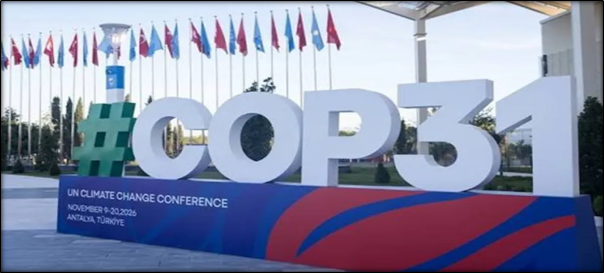
The 31st Conference of Parties (COP31), being held in Antalya, Türkiye, in November 2026, has brought the credibility of global climate commitments into focus. Developing countries are demanding the fulfilment of existing promises on climate finance, adaptation and technology transfer before accepting new ambitious targets.
Introduction
COP31 highlights a fundamental weakness in global climate governance: the widening gap between international climate commitments and their actual implementation, particularly in providing adequate financial and technological support to vulnerable developing countries.
COP31: Significance and emerging priorities
- Protection of vulnerable countries: Small Island Developing States (SIDS), which contribute minimally to global greenhouse gas emissions, face disproportionately severe consequences from sea-level rise, coastal erosion, extreme weather events and ocean warming.
- Shift from commitments to implementation: Unlike earlier climate negotiations that largely focused on setting emission-reduction targets, COP31 is increasingly concerned with ensuring that countries fulfil their existing financial and mitigation commitments.
- Climate finance as a central negotiating issue: Developing countries are demanding predictable, accessible and adequate financial resources to implement climate adaptation and mitigation measures.
- Adaptation finance: COP30 had called for a substantial expansion of adaptation finance, including efforts to triple it by 2035. COP31 faces the challenge of translating such commitments into actual financial flows.
- Fossil fuel transition: The absence of a formal roadmap for transitioning away from fossil fuels following COP30 has revived concerns about the pace and credibility of global decarbonisation.
- Climate technology transfer: Developing countries require affordable access to renewable energy technologies, energy storage systems, climate-resilient infrastructure and low-carbon industrial technologies.
Climate finance: The central pillar of COP31 negotiations
1. Climate Finance Commitments: The NCQG agreed at COP29 envisages mobilising at least $300 billion annually by 2035 for developing countries, while COP30 emphasised scaling up adaptation finance to strengthen climate resilience.
2. Loss and Damage Financing: The Loss and Damage Fund aims to support climate-vulnerable countries facing irreversible losses due to extreme weather events, sea-level rise and other climate impacts; however, its limited funding remains a major concern.
3. Implementation and Equity Challenges: Inadequate and delayed finance, excessive dependence on loans and unequal access to funds widen the gap between developing countries’ NDC commitments and implementation capacity, undermining trust between developed and developing nations.
Global Stocktake and the role of IPCC
- Global Stocktake (GST): It is a periodic assessment under the Paris Agreement to evaluate collective progress towards achieving its climate goals, including mitigation, adaptation and means of implementation.
- Second Global Stocktake: The preparations and discussions associated with the next assessment cycle are important because they will evaluate whether countries are collectively progressing towards the Paris Agreement’s temperature goals.
- Importance of scientific assessment: The Intergovernmental Panel on Climate Change (IPCC) provides scientific assessments of climate change, its impacts, vulnerabilities and mitigation options.
Major Challenges Associated with Global Climate Governance
1. Financial challenges
- Inadequate climate finance: The financial commitments made by developed countries remain insufficient in relation to the actual requirements of developing countries for mitigation and adaptation.
- Uncertainty over financial mobilisation: The $300-billion annual goal by 2035 raises questions regarding the contribution of public finance, private investment, multilateral development banks and other sources.
2. Geopolitical and diplomatic challenges
- North-South divide: Developed and developing countries continue to disagree over historical responsibility, financial obligations, emission-reduction targets and technology transfer.
- Geopolitical conflicts: Wars and international tensions divert financial resources towards defence and reconstruction, reducing the political and economic attention given to climate action.
3. Technological and infrastructural challenges
- Technology divide: Developing countries often lack access to affordable renewable energy technologies, advanced battery storage, green hydrogen and carbon capture technologies.
- Grid infrastructure limitations: Large-scale renewable energy integration requires modern transmission networks, storage systems and flexible electricity markets.
4. Environmental and developmental challenges
- Unequal climate vulnerability: Countries contributing the least to global emissions often experience disproportionately severe climate impacts.
- Climate-induced displacement: Sea-level rise, droughts, floods and extreme weather events threaten livelihoods, food security and human settlements.
5. Institutional challenges
- Weak enforcement mechanisms: The Paris Agreement relies heavily on nationally determined commitments and transparency mechanisms rather than legally binding emission-reduction targets backed by punitive enforcement.
- Implementation deficit: The gap between countries’ announced climate commitments and actual domestic policy implementation undermines global climate governance.
Way Forward: India’s Position and Significance in COP31
1. Climate Finance and CBDR-RC: India should advocate adequate, predictable and accessible climate finance from developed countries, guided by CBDR-RC, to address historical responsibilities and bridge the climate financing gap.
2. Equitable and Nationally Determined Transition: India should promote nationally determined energy transition pathways rather than uniform targets, considering energy security, coal dependence, poverty reduction and developmental priorities.
3. Technology Transfer and Green Infrastructure: India should demand affordable clean technology transfer and international cooperation while promoting investments in renewable energy, battery storage, green hydrogen and modern electricity grids.
4. Climate Adaptation and Resilience: India should push for greater adaptation finance, disaster risk reduction, early warning systems and climate-resilient infrastructure to protect vulnerable communities and address climate-induced displacement.
5. Institutional Accountability and Implementation: India should support stronger transparency, monitoring and reporting mechanisms under the Paris Agreement to bridge the gap between climate commitments and actual implementation while ensuring equity.
Conclusion
COP31 must mark a transition from climate diplomacy based on ambitious announcements to accountable implementation. Equitable finance, technology transfer and a just energy transition are essential to building trust and achieving meaningful global climate action.
| Important Current to Concept From This Article for UPSC Small Island Developing States (SIDS) Common but Differentiated Responsibilities and Respective Capabilities (CBDR-RC) |