
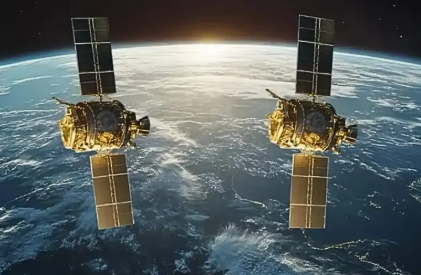
About Space Docking
- Meaning: Space docking is the process of joining two spacecraft in orbit to form a single connected structure.
- Related Technology: It involves rendezvous, navigation, proximity operations and docking mechanisms.
- Indian Mission: India demonstrated indigenous space docking technology through the Space Docking Experiment (SpaDeX) mission.
- Organisation: Indian Space Research Organisation (ISRO).
- Launch: Launched on 30 December 2024 aboard PSLV-C60 from Sriharikota.
- Achievement: India successfully docked two SpaDeX satellites on 16 January 2025, becoming the fourth country to demonstrate space docking technology.
- Objective: Develop indigenous capabilities for in-space docking, spacecraft control and future human spaceflight and space-station missions.
Major Features and Technologies
1. Rendezvous and Docking
- Rendezvous: The process through which two spacecraft approach each other and reach the same orbital position.
- Docking: The process of physically connecting two spacecraft in orbit.
- Undocking: The process of separating two previously docked spacecraft.
2. SpaDeX Mission (Space Docking Experiment)
- A technology-demonstration mission designed to test autonomous rendezvous, docking and undocking of two small spacecraft.
- Consisted of two satellites:
- SDX-01 (Chaser): Approaches and docks with the target satellite.
- SDX-02 (Target): Serves as the spacecraft with which the chaser docks.
- Both satellites weighed approximately 220 kg each.
- Operated in a low-Earth orbit of approximately 470 km altitude.
3. Indigenous Technologies Developed
- Docking Mechanism: Low-impact, androgynous docking system, with identical docking interfaces on both spacecraft.
- Rendezvous Sensors: Help determine the relative position and distance between spacecraft.
- Laser Range Finder (LRF): Measures distance during the approach.
- Inter-Satellite Communication: Enables autonomous communication between the two spacecraft.
- Relative Orbit Determination and Propagation (RODP): Uses GNSS-based measurements to determine relative position and velocity.
- Power Transfer System: Enables electrical power transfer between docked spacecraft.
Significance of Space Docking Technology
- Bharatiya Antariksh Station: Essential for assembling and operating India’s proposed space station.
- Chandrayaan-4: Enables the transfer of lunar samples between spacecraft in orbit.
- Human Spaceflight: Supports future crewed missions involving spacecraft rendezvous and docking.
- In-Space Servicing: Facilitates satellite refuelling, repair and maintenance.
- Space Exploration: Enables complex missions requiring multiple spacecraft to work together.
- Technological Self-Reliance: Strengthens India’s indigenous capabilities in advanced space technologies.
Conclusion
Space docking technology represents a major advancement in India’s space capabilities. Through the SpaDeX mission, India has demonstrated indigenous capabilities essential for future lunar exploration, human spaceflight and the establishment of the Bharatiya Antariksh Station.
| This concept has been mentioned in the following article: COSMOS-Mysuru Planetarium |