
Context
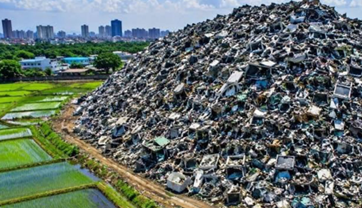
Wayanad in Kerala is set to become India’s first e-waste-free model district after collecting nearly 100 tonnes of electronic waste through a district-wide campaign.
Wayanad’s E-Waste Collection Drive
- Total Collection: 97.26 metric tonnes of e-waste.
- Coverage: 26 local self-government institutions.
- Implementing Agencies: Suchitwa Mission and Clean Kerala Company.
- Collection Mechanism: Haritha Karma Sena collected e-waste from households, while Clean Kerala Company collected it from government offices and schools.
E-Waste Management in India
(a) E-Waste (Management) Rules, 2022
- Notified under the Environment (Protection) Act, 1986; came into force on 1 April 2023.
- Replaced the E-Waste (Management) Rules, 2016.
- Apply to manufacturers, producers, refurbishers and recyclers of electrical and electronic equipment specified under the Rules.
- Introduce an Extended Producer Responsibility (EPR)-based recycling framework.
(B) Extended Producer Responsibility (EPR)
- Makes producers responsible for meeting prescribed e-waste recycling obligations.
- Recycling obligations are fulfilled through EPR certificates generated by registered recyclers.
- The framework promotes formal recycling, resource recovery and environmentally sound management of e-waste.
(C) Circular Economy
E-waste management promotes a circular economy by:
- Recovering valuable materials from discarded electronic products.
- Reducing dependence on virgin raw materials.
- Minimising waste generation and environmental pollution.
- Extending the life of electronic products through refurbishment and reuse.
Institutional Framework
- Ministry of Environment, Forest and Climate Change of India: Formulates the regulatory framework for e-waste management.
- Central Pollution Control Board (CPCB): Implements the EPR framework, maintains the portal and monitors compliance.
- State Pollution Control Boards (SPCBs) and Pollution Control Committees (PCCs): Monitor and enforce compliance at the state and Union Territory levels.
- Local Bodies: Facilitate decentralised collection and public participation in waste management.
Wayanad’s initiative demonstrates how decentralised collection, institutional coordination and community participation can complement India’s formal e-waste management framework.
| Important CTC from this article: Central Pollution Control Board (CPCB) |
                                          MCQ


Q. With respect to the E-Waste (Management) Rules, 2022 in India, consider the following statements:

I. Solar photovoltaic modules, panels, and cells are brought under the purview of these rules.
II. Micro-enterprises, as defined under the Micro, Small and Medium Enterprises Development Act, 2006, are mandatorily subject to these rules.
III. Producers must fulfil their Extended Producer Responsibility (EPR) recycling targets through registered recyclers via a centralized portal managed by the Central Pollution Control Board (CPCB).

Which of the statements given above are correct?

(a) I and II only
(b) II and III only
(c) I and III only
(d) I, II and III

Answer: (c) I and III only

Explanation:
• Statement I is correct: The E-Waste (Management) Rules, 2022, notified by the Ministry of Environment, Forest and Climate Change (MoEFCC) under the Environment (Protection) Act, 1986, explicitly include solar photovoltaic modules, panels, and cells within the definition of e-waste. Manufacturers and producers of solar photovoltaic equipment are required to register on the portal and store generated solar waste up to the year 2034–35 as per CPCB guidelines.
• Statement II is incorrect: The rules explicitly exempt micro-enterprises (as defined under the MSME Development Act, 2006), along with waste batteries (covered under the Battery Waste Management Rules, 2022), packaging plastics (covered under the Plastic Waste Management Rules, 2016), and radioactive wastes (covered under the Atomic Energy Act, 1962).
• Statement III is correct: Under the Extended Producer Responsibility (EPR) framework, all producers of notified electrical and electronic equipment must register on the CPCB centralized portal and meet their prescribed recycling targets exclusively by purchasing EPR certificates from registered recyclers.


                                       PYQ


Due to improper/indiscriminate disposal of old and used computers or their parts, which of the following are released into the environment as e-waste?

1. Beryllium
2. Cadmium
3. Chromium
4. Heptachlor
5. Mercury
6. Lead
7. Plutonium


Select the correct answer using the codes given below:

A. 1, 3, 4, 6 and 7 only
B. 1, 2, 3, 5 and 6 only
C. 2, 4, 5 and 7 only
D. 1, 2, 3, 4, 5, 6 and 7