
Context
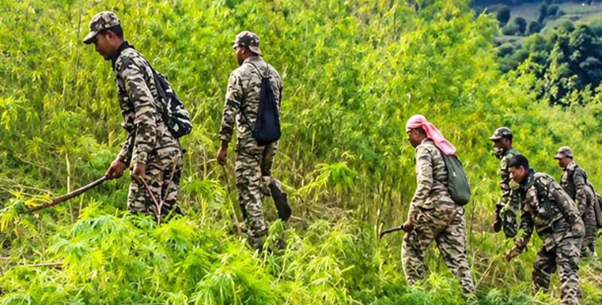
The NCB has launched multi-State operations against illegal cannabis and opium poppy cultivation, destroying over 1.37 lakh kg of cannabis plants across 458 acres in Arunachal Pradesh. The drive aims to eliminate illicit cultivation by December 2027 under the MHA’s Vision Document on Narcotics Control (2026–2029) through inter-agency coordination and a whole-of-government approach.
About the NCB-Led Anti-Narcotics Drive
- Nodal Agency: The Narcotics Control Bureau (NCB) is leading operations against illegal cannabis and opium cultivation in coordination with Central and State agencies.
- Geographical Coverage: Operations target forest areas, remote hill districts and community lands across identified States.
- Inter-Agency Coordination: The drive involves NCB, State police, CRPF, SSB, Anti-Narcotics Task Forces and district administrations.
- Hotspot Mapping: Agencies identify vulnerable areas to facilitate targeted surveillance and destruction of illicit crops.
- Capacity Building: NCB conducts training programmes on intelligence collection and identification of illegal cultivation sites.
- Target: Eliminate illicit cannabis and poppy cultivation in identified areas by December 2027 through a whole-of-government approach.
Important Concepts Related to Narcotics Control
1. Narcotic Drugs and Psychotropic Substances (NDPS) Act, 1985
- Objective: Provides the legal framework for controlling narcotic drugs and psychotropic substances in India.
- Section 8: Prohibits cultivation of cannabis and opium poppy and other specified activities, except as permitted under the Act.
- Medical and Scientific Use: Allows regulated use of narcotic substances for medical and scientific purposes.
- Regulation: Governs production, manufacture, possession, sale, transportation, import and export of narcotic substances.
2. Cannabis (Hemp)
- Definition: Cannabis refers to plants belonging to the genus Cannabis.
- Charas: Separated cannabis resin, whether crude or purified.
- Ganja: Flowering or fruiting tops of the cannabis plant, excluding seeds and leaves when not accompanied by the tops.
- Cannabis Plant: Any plant belonging to the genus Cannabis under the NDPS Act.
- Legal Status: Cultivation is generally prohibited, except for permitted purposes under the NDPS Act.
3. Opium and Opium Poppy
- Opium Poppy: Plant of the species Papaver somniferum L., used for obtaining opium.
- Opium: Coagulated juice of the opium poppy.
- Morphine: Naturally occurring opium alkaloid used as a powerful pain-relieving medicine.
- Codeine: Opium alkaloid used in certain pain-relief and cough medicines.
- Poppy Straw: All parts of the opium poppy, except seeds, after harvesting.
- Legal Regulation: Opium poppy cultivation is permitted only under the prescribed licensing and regulatory framework.
4. Narcotics Control Bureau (NCB)
- Establishment: Established on 17 March 1986 under the NDPS Act, 1985.
- Administrative Control: Functions under the Ministry of Home Affairs (MHA).
- Headquarters: New Delhi.
- Nodal Agency: Coordinates national efforts to combat drug abuse and illicit trafficking.
- Key Functions: Intelligence collection, investigation, enforcement operations and coordination with Central, State and international agencies.
5. Whole-of-Government Approach in Narcotics Control
- Inter-Agency Coordination: Promotes cooperation among Central ministries, State governments, police and intelligence agencies.
- Intelligence Sharing: Helps identify cultivation hotspots, trafficking routes and criminal networks.
- Integrated Enforcement: Facilitates coordinated surveillance and destruction of illicit crops.
- Capacity Building: Improves the ability of enforcement personnel to detect illegal cultivation.
- Community Participation: Encourages local communities and district administrations to support grassroots monitoring.
| Important CTC from this Article: MHA’s Vision Document on Narcotics Control (2026–2029) |
                                        MCQ


Q. Consider the following statements regarding narcotics control in India:

1. The Narcotics Control Bureau functions under the Ministry of Home Affairs.
2. The NDPS Act, 1985 prohibits the cultivation of cannabis and opium poppy, except as permitted under the Act and applicable rules.
3. Ganja refers to the separated resin obtained from the cannabis plant.
4. The United Nations Office on Drugs and Crime (UNODC) is headquartered in Vienna, Austria.

Which of the statements given above are correct?

(a) 1 and 2 only
(b) 1, 2 and 4 only
(c) 2, 3 and 4 only
(d) 1, 2, 3 and 4

Correct Answer: (b) 1, 2 and 4 only

Explanation:
• Statement 1 is correct: The Narcotics Control Bureau functions under the Ministry of Home Affairs and serves as the national nodal agency for combating illicit drug trafficking.
• Statement 2 is correct: Section 8 of the NDPS Act, 1985 prohibits the cultivation of cannabis and opium poppy, subject to permitted medical and scientific purposes and applicable regulatory provisions.
• Statement 3 is incorrect: Ganja refers to the flowering or fruiting tops of the cannabis plant. The separated resin obtained from the cannabis plant is known as charas.
• Statement 4 is correct: The UNODC is headquartered in Vienna, Austria, and works towards combating illicit drugs and international organised crime.