
Important for GS Prelims: Geography
Origin and Course
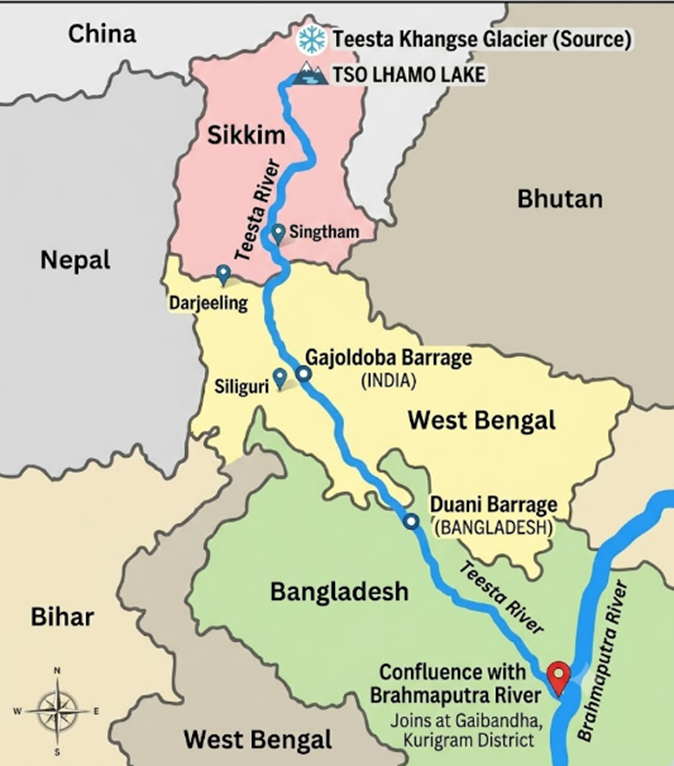
- Source: It originates at an elevation of about 5,280 meters from Tso Lhamo (Chho Lhamo) Lake in the North Sikkim district. It is glacier-fed, drawing water from the Pahunri and Khangse glaciers.
- Course: It flows southwards through Sikkim and West Bengal. It carves a deep gorge through the Siwalik Hills (Outer Himalayas) east of Darjeeling before entering the plains of West Bengal via the Sivok Khola pass.
- Terminal Point: It enters Bangladesh (Rangpur division) and flows into the Brahmaputra River (known as the Jamuna in Bangladesh) on its right bank at Fulchori. Historically, prior to a major avulsion (course shift) caused by the devastating floods of 1787, the Teesta was a major tributary of the Ganga.
Catchment and Basin Profile
- Total Length: About 414 km.
- Basin Allocation: The river basin is shared between India and Bangladesh. Roughly 83% of the catchment area lies within India (distributed between Sikkim and West Bengal), while only 17% lies in Bangladesh.
- Ecological lifelines: Known as the “lifeline of Sikkim” and half-a-dozen districts of North Bengal.
Major Tributaries
| Right-Bank Tributaries | Left-Bank Tributaries |
| Rangit River (Largest tributary; originates in West Sikkim) | Lachung Chhu |
| Zemu Chhu | Dik Chhu |
| Rangyong Chhu | Rani Khola & Rangpo Chhu |
Key Infrastructure and Barrages
- Gajoldobha Barrage: Located in Jalpaiguri, India, which diverts water into the Teesta-Mahananda link canal.
- Duani (Dalia) Barrage: Located in Bangladesh, regulating water distribution for the Teesta Barrage Project irrigation scheme.
- Hydroelectric Projects: The steep gradients make it highly lucrative for hydropower. Major operational plants include Teesta-III (1200 MW) in Mangan district, Sikkim, and the Teesta Low Dam projects (TLDP III & IV) in West Bengal.
Bilateral Water Dispute & Geopolitics
- Core Issue: Dispute over dry-season (Dec–Mar) Teesta water sharing. Bangladesh seeks adequate flow for Boro rice cultivation, while West Bengal cites irrigation and hydropower needs.
- Constitutional Angle: Article 253 empowers the Union to sign treaties, but Water (Entry 17, State List) and cooperative federalism have delayed a final agreement due to West Bengal’s concerns.
- Recent Geopolitical Twist: Bangladesh’s Teesta River Comprehensive Management and Restoration Project (TRCMRP) has intensified India–China strategic competition, as the river lies close to India’s strategically significant Siliguri Corridor (“Chicken’s Neck”).
Conclusion:
- The Teesta River is a strategically important transboundary Himalayan river that plays a vital role in regional hydrology, irrigation, hydropower, and India–Bangladesh water cooperation.
| This concept has been elaborately discussed in the following article: Toxic Methane Gas Leak in Sikkim Tunnel |