Context
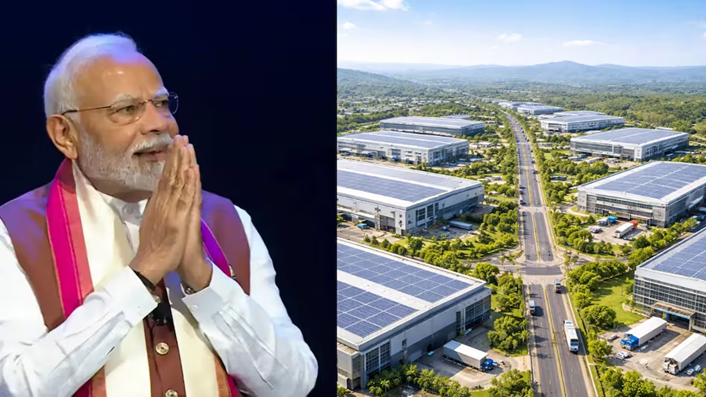
Recently, the Union Cabinet chaired by the Prime Minister has approved the Bharat Audyogik Vikas Yojana (BHAVYA). This flagship scheme, with a significant financial outlay of ₹33,660 crore, aims to transform India’s manufacturing landscape by developing 100 high-end “plug-and-play” industrial parks across the country. The move is seen as a strategic step to counter “premature de-industrialization” and achieve the goal of a Viksit Bharat by enhancing domestic manufacturing capabilities and generating approximately 15 lakh direct jobs.
1. Overview and Objectives
The Bharat Audyogik Vikas Yojana (BHAVYA) is a central sector initiative designed to provide world-class, investment-ready infrastructure.
- Goal: To build 100 industrial parks that allow companies to move from “intent to production” with minimal delay.
- Primary Target: Boosting the manufacturing sector’s contribution to the GDP and creating large-scale employment.
- Focus Areas: Ease of Doing Business (EoDB), deregulation, and streamlined single-window clearances.
2. Infrastructure and Funding Model
The scheme introduces a robust financial support mechanism to ensure the quality of these industrial ecosystems:
- Grant Support: The Central Government will provide a grant of up to ₹1 crore per acre for core infrastructure development.
- External Connectivity: The Centre will fund up to 25% of the cost for external infrastructure (roads, rail links, etc.) to ensure seamless multimodal connectivity.
- Scale of Parks: General Regions: Minimum area of 100 acres (scaling up to 1,000 acres).
- North-Eastern and Hilly States: Minimum area of 25 acres to suit the local terrain.
3. Key Features of BHAVYA
- Plug-and-Play Facilities: These parks will offer ready-to-use factory sheds, testing laboratories, and pre-approved environmental and building clearances.
- Challenge Mode Selection: Projects will be selected through a competitive “Challenge Mode” among states to ensure only high-quality, reform-oriented proposals receive funding.
- PM GatiShakti Alignment: The parks are designed based on the National Master Plan (NMP) for multimodal connectivity, ensuring efficient logistics and “no-dig” underground utility corridors.
- Social Infrastructure: Unlike traditional industrial zones, BHAVYA includes provisions for worker housing, health centers, and basic amenities within the park to support the workforce.
4. Implementation Agency
The National Industrial Corridor Development Corporation (NICDC), under the Department for Promotion of Industry and Internal Trade (DPIIT), will be the lead agency for executing the scheme in partnership with State Governments and the private sector.
Q. With reference to the 'Bharat Audyogik Vikas Yojana (BHAVYA)', consider the following statements:

1. It is a scheme aimed at developing 100 plug-and-play industrial parks with a focus on reducing the time between investment intent and actual production.

2. Under this scheme, the Central Government provides financial support of up to ₹10 crore per acre for the development of internal roads and ICT systems.

3. The selection of industrial parks under the scheme follows a 'Challenge Mode' to incentivize reforms at the state level.

How many of the above statements are correct?
(a) Only one
(b) Only two
(c) All three
(d) None

Solution: Answer: (b) (Only two)

•	STATEMENT 1 IS CORRECT: The primary objective of BHAVYA is to provide "investment-ready" land and infrastructure to accelerate industrialization.
•	STATEMENT 2 IS INCORRECT: The financial support provided by the Central Government is up to ₹1 crore per acre (not ₹10 crore) for core and value-added infrastructure.
•	STATEMENT 3 IS CORRECT: The scheme utilizes a Challenge Mode selection process to ensure that only those states that are willing to implement investor-friendly reforms and have high-quality proposals are selected.