
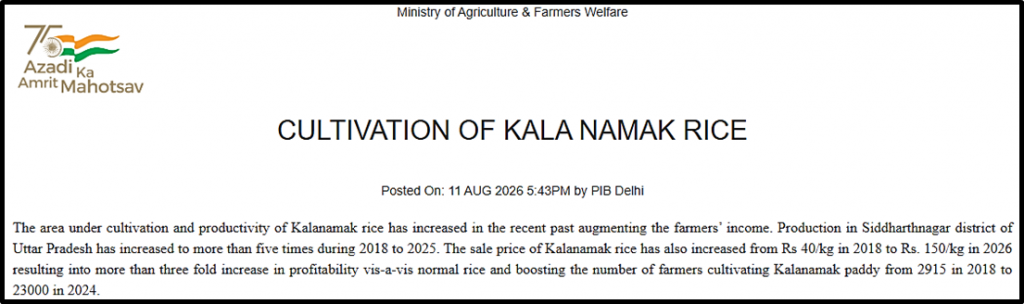
Kalanamak rice, a scented, black-husked traditional rice variety historically linked to the Buddha and cultivated primarily in the Siddharthnagar district and adjoining Terai belt of Uttar Pradesh, has seen rising area, productivity and farmer income under coordinated Central and State support. Production in Siddharthnagar increased more than five times, while the sale price rose almost four times, more than tripling profitability over normal rice and also expanding the farmer base.
Government Support & Schemes
- Credit-linked capital subsidy up to 35% (max ₹10 lakh) for micro-units/FPOs under PM Formalisation of Micro Food Processing Enterprises (PMFME) and One District One Product (ODOP) Margin Money Scheme (state-funded)
- Common Facility Centre (CFC) set up in Siddharthnagar under ODOP for processing, packaging and export-support facilities
- Brand promotion through Kalanamak Mahotsavs; dedicated State project funding earmarked for promotion, production and processing
Varietal Development
- Led by the National Agricultural Research System (NARS) under ICAR; six improved varieties released — Kalanamak KN3, Bauna Kalanamak 101, Bauna Kalanamak 102, Kalanamak Kiran, Pusa Narendra Kalanamak 1 and Pusa CRD Kalanamak 2
- Dwarf high-yielding varieties give 4.5 tons/ha vs 2.5 tons/ha for traditional varieties
- Over 1,700 land races/local varieties registered with the Protection of Plant Varieties and Farmers Rights Authority (PPV&FRA); KVKs notified within the Geographical Indication (GI) area for multi-location testing
Export & Branding
- Export facilitated by Agricultural and Processed Food Products Export Development Authority (APEDA), linking FPOs to buyers in Singapore and Nepal
- Marketed globally as “Buddha Rice” targeting high-value Buddhist-majority markets — Japan, Thailand, Vietnam, Singapore, Myanmar
- Siddharthnagar and surrounding Terai districts integrated into APEDA’s Agri-Export Zone framework for specialty rice, aiding export packaging, residue testing and quarantine compliance
Conclusion
Coordinated Central-State support through PMFME and ODOP, ICAR-led varietal development, GI-based conservation, and APEDA-facilitated export branding as “Buddha Rice” have jointly expanded Kalanamak rice cultivation, productivity and farmer income in the Siddharthnagar-Terai belt of Uttar Pradesh.