
After Reading This Article You Can Solve This UPSC Mains Model Question:
The credibility of the international human rights regime is increasingly being tested by its inability to ensure accountability for violations of international humanitarian law. Examine the challenges in ensuring accountability for alleged Israeli atrocities in Palestine and discuss India’s role in this context. 15 Marks (GS 2, International Relations)
Context
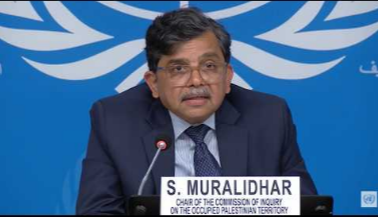
- The International Commission of Inquiry, chaired by retired Indian judge Justice Srinivasan Muralidhar, has reported alleged war crimes, crimes against humanity and genocide by Israeli security forces in Palestinian territories.
- The report raises questions about the effectiveness of international institutions, the enforcement of international humanitarian law and India’s commitment to its stated foreign policy principles.
Background: Understanding the Issue
- October 7, 2023: Hamas launched an attack on Israel, triggering a prolonged military conflict in Gaza and other Palestinian territories.
- International Commission of Inquiry: Established by the UN Human Rights Council to investigate violations of international human rights law and humanitarian law in the occupied Palestinian territories and Israel.
- Nature of allegations: The latest report examines killings and physical and psychological harm inflicted on Palestinian civilians by state actors.
- Evidence base: Medical records, satellite imagery, forensic analysis, witness testimonies and videos have been used to document alleged violations.
Major Findings of the Report
- Civilian casualties: According to the report cited in the editorial, over 75,000 Palestinians, including 21,500 children and 11,000 women, have been killed since 2023.
- Targeting of civilians: Allegations of deliberate attacks against Palestinian civilians, including children and infants.
- Weaponisation of AI: Concerns over the use of Artificial Intelligence in identifying targets, potentially enabling large-scale killings with inadequate human oversight.
- State accountability: Alleged involvement and public statements of senior Israeli officials raise questions about command responsibility.
- Lack of accountability: Limited action by member states to investigate, prosecute or prevent alleged violations.
Major Challenges in Ensuring International Accountability
A. Institutional and Structural Challenges
- UN Security Council paralysis: Veto power and geopolitical divisions, particularly US support for Israel, constrain collective action.
- Limited enforcement capacity of UNGA: General Assembly resolutions are largely recommendatory and lack independent enforcement mechanisms.
- Selective application of international law: Powerful states can evade international scrutiny, undermining the principle of sovereign equality.
B. Geopolitical Challenges
- Great power rivalry: Strategic alliances and military partnerships often take precedence over humanitarian considerations.
- US–Israel strategic partnership: Military, diplomatic and political support limits international pressure on Israel.
- Fragmented international response: Differences among countries prevent the formation of a unified diplomatic position.
C. Legal and Accountability Challenges
- Enforcement deficit: International institutions often lack independent mechanisms to enforce their findings and decisions.
- Jurisdictional limitations: The International Criminal Court (ICC) depends significantly on state cooperation for arrests and enforcement.
- Accountability gap: Political considerations frequently obstruct investigations and prosecution of alleged perpetrators.
D. Emerging Technological Challenges
- AI-enabled warfare: Algorithmic targeting can increase the scale and speed of military operations.
- Lack of human oversight: Automated decision-making raises concerns about distinguishing civilians from combatants.
- Responsibility gap: Determining accountability among military commanders, software developers and state authorities remains challenging.
India’s Position: Between Strategic Interests and Moral Commitments
India’s response reflects an attempt to balance its traditional support for Palestinian rights with its expanding strategic partnership with Israel.
A. India’s Traditional Position
- India has historically supported the Palestinian cause and the two-state solution.
- Supports the establishment of a sovereign, independent and viable Palestinian state living alongside Israel in peace and security.
- Provides humanitarian assistance to Palestinians.
B. Growing Strategic Partnership with Israel
- Defence cooperation involving military equipment, ammunition, ordnance and drone components.
- Cooperation in agriculture, water management, science and technology, and counterterrorism.
- Expanding strategic engagement in West Asia.
C. Contradictions in India’s Approach
- Abstention from certain UN resolutions seeking a ceasefire or action against Israel, as highlighted in the editorial.
- Limited public criticism of alleged violations of international humanitarian law.
- Perceived inconsistency between India’s commitment to human rights and its diplomatic response.
Philosophical Perspective: From Power Politics to Ethical Internationalism
The Palestine crisis highlights the tension between political realism (national interest) and ethical universalism (human dignity and universal human rights) in international relations.
- Kant’s Perpetual Peace: International peace must rest on a rules-based international order rather than the arbitrary exercise of power by states.
- Vasudhaiva Kutumbakam: The world is one family; humanitarian concerns must transcend geopolitical alliances and national boundaries.
- Gandhian Ethics: Means are as important as ends; national security cannot become a justification for disregarding human dignity and civilian lives.
Way Forward
A. Strengthening Multilateral Institutions
- Reform the UN Security Council to make it more representative, accountable and responsive.
- Restrict the use of veto power in situations involving mass atrocities and genocide.
- Strengthen the investigative and monitoring capacity of UN human rights mechanisms.
B. Ensuring International Accountability
- Encourage cooperation with the ICC and enforcement of valid arrest warrants.
- Promote independent investigations into alleged violations of international humanitarian law.
- Consider targeted sanctions and restrictions on military transfers where legally justified.
C. Regulating AI in Warfare
- Establish internationally agreed standards for the military use of AI.
- Ensure meaningful human control over lethal autonomous weapons.
- Strengthen transparency, traceability and accountability in algorithmic targeting.
D. India’s Diplomatic Response
- Maintain a consistent position on Palestinian self-determination and the two-state solution.
- Support independent international investigations into alleged violations.
- Ensure that defence cooperation remains consistent with international humanitarian law and applicable export-control obligations.
- Use its diplomatic influence to promote dialogue, humanitarian access and a sustainable ceasefire.
Conclusion
The Palestine crisis exposes a fundamental contradiction in the international order: while international law establishes universal standards of human rights and humanitarian protection, its enforcement remains vulnerable to geopolitical interests.
India must pursue a foreign policy that balances strategic autonomy with normative consistency, while supporting a rules-based international order where no state is above international law.
| Important Current to Concept From This Article for UPSC International Criminal Court (ICC) United Nation Security Council (UNSC) |