
Context
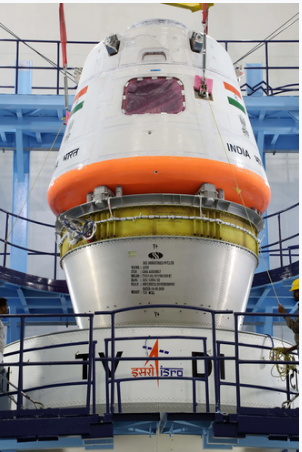
- As part of India’s maiden human spaceflight program, Gaganyaan, ISRO is deploying an Environmental Control and Life Support System (ECLSS). This system is designed to replicate Earth’s atmospheric conditions inside the crew module while orbiting at an altitude of 400 km in Low Earth Orbit (LEO).
Core Components of ECLSS
- The ECLSS manages four critical domains to keep astronauts alive and comfortable in microgravity: Air, Water, Temperature, and Waste.
- For short-term missions like Gaganyaan, all supplies are carried from Earth and waste is stored for post-mission disposal (unlike long-duration missions on the ISS, which actively recycle waste into resources).
1. Air Revitalisation System (ARS)
The ARS performs three primary functions: providing fresh oxygen (O2), removing carbon dioxide (CO2), and filtering trace contaminants/odors.
- CO2 Removal Mechanism: Uses Lithium Hydroxide (LiOH) canisters to chemically scrub CO2 from the cabin air.
- Lithium Hydroxide (LiOH) is a highly alkaline inorganic compound primarily utilized in the production of high-performance EV battery cathodes, heavy-duty industrial lubricating greases, and specialized carbon dioxide scrubbers for aerospace and maritime environments.
- Medical Risk Mitigated: Prevents Hypercapnia (elevated CO2 levels in the blood), which causes headaches, dizziness, and impaired cognitive function.
- Daily Human Metabolic Metrics (Standard Requirements):
- Oxygen Consumption: A healthy crew member needs 0.84 kg of O2 per day.
- CO2 Exhalation: A healthy adult exhales approximately 1 kg of CO2 per day
- Air Circulation Challenge: In microgravity, natural convection does not occur. The ECLSS uses small fans to force air circulation, preventing lethal pockets of stagnant CO2 or hazardous oxygen pockets from accumulating around the crew.
2. Pressure, Temperature, and Humidity Control
To ensure crew safety and protect onboard electronics, the cabin environment is tightly regulated within strict baseline parameters:
| Parameter | Controlled Target Baseline | Technical Mechanism / Challenge |
| Atmospheric Pressure | 101.3 kPa (Mimics Earth’s sea-level pressure) | Regulated via electronic sensors and safety valves that perfectly balance air and oxygen levels. |
| Temperature | 20°C to 26°C | Heat is generated by astronaut metabolism (100–150 W per crew member) and onboard avionics. An active cooling system circulates air through heat exchangers, which expel excess heat into space. |
| Relative Humidity | 30% to 70% | Managed by condensing units that collect water. • Too low: Dry skin, eye irritation, and high risk of static electricity discharge (damages electronics). • Too high: Microbial growth and condensation, risking short-circuits or corrosion. |
3. Water and Fluid Management in Microgravity
- The Fluid Behavior Challenge: In microgravity, water does not “pour” or flow due to gravity; instead, it surface-tensions into floating globules. These globules pose a severe risk of causing short-circuits in electronics or choking hazards if accidentally inhaled by astronauts.
- Gaganyaan’s Solution: Potable water is stored in specially designed pouches featuring pressurized bladders. These bladders mechanically force the water directly into the astronaut’s mouth without allowing gas-liquid mixing.
4. Waste Management
- Storage Philosophy: For the short-duration Gaganyaan mission, liquid and solid wastes are mechanically collected and stored securely inside the module for disposal after landing, rather than being recycled in-situ.
| About Gaganyan The Gaganyaan mission is India’s premier human spaceflight program. It aims to launch a crew of three astronauts into a Low Earth Orbit (LEO) at an altitude of 400 km for a 3-to-7 day mission, and safely return them to Earth, landing in Indian sea waters. Prior to the crewed launch, the program mandates several precursor uncrewed missions to test systems, including a module carrying the humanoid robot Vyommitra. |
With reference to the Environmental Control and Life Support System (ECLSS) of the Gaganyaan mission, consider the following statements:
1. The Air Revitalisation System (ARS) uses Lithium Hydroxide canisters to remove carbon dioxide from the cabin air.
2. In microgravity, natural convection helps maintain proper air circulation inside the crew module.
3. The Gaganyaan mission plans to recycle waste into usable resources during the mission, similar to the International Space Station (ISS).
Which of the statements given above is/are correct?
(a) 1 only
(b) 1 and 2 only
(c) 2 and 3 only
(d) 1, 2 and 3
Answer:
(a) 1 only
Explanation:
• Statement 1 is correct: The ARS uses Lithium Hydroxide (LiOH) canisters to scrub CO₂ from cabin air.
• Statement 2 is incorrect: In microgravity, natural convection does not occur; fans are required for air circulation.
• Statement 3 is incorrect: For short-duration missions like Gaganyaan, waste will be stored and disposed of after landing, not recycled like on the ISS.