
Context
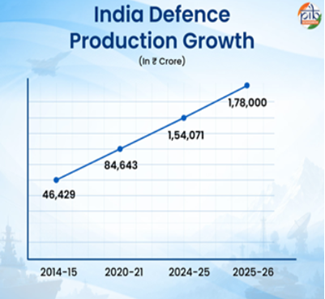
- Recently, the Ministry of Defence (MoD) announced that India’s annual defence production reached an all-time high of ₹1.78 lakh crore in FY 2025–26, registering a 15.6% increase over the previous financial year.
- The milestone reflects the success of the Government’s Aatmanirbhar Bharat initiative, defence indigenisation policies, and growing participation of the private sector in defence manufacturing.
Key Highlights
I. Defence Production
- Record Production: ₹1.78 lakh crore in FY 2025–26.
- Growth: 15.6% over FY 2024–25.
- Production has more than doubled since FY 2013–14 (₹43,746 crore).
II. Contribution
- Defence Public Sector Undertakings (DPSUs): ~76% of total production.
- Private Sector: ~24% of total production, with increasing participation in indigenous manufacturing.
Government Initiatives Driving Defence Indigenisation
I. Aatmanirbhar Bharat in Defence
- Promotes indigenous design, development, and manufacturing of defence equipment.
- Reduces dependence on imports and strengthens strategic autonomy.
II. Defence Acquisition Procedure (DAP), 2020
- Gives preference to Buy (Indian–IDDM) (Indigenously Designed, Developed and Manufactured).
- Encourages procurement from domestic industries.
III. Positive Indigenisation Lists
- Ministry of Defence has notified multiple Positive Indigenisation Lists banning the import of specified defence items within stipulated timelines.
- Separate lists have also been issued by DPSUs for indigenous procurement of components and sub-systems.
IV. Innovations for Defence Excellence (iDEX)
- Launched in 2018.
- Supports start-ups, MSMEs, innovators, and academia in developing indigenous defence technologies.
V. SRIJAN Portal
- Online portal launched by the Ministry of Defence.
- Facilitates indigenisation of imported defence items by connecting DPSUs, armed forces, and domestic industries.
VI. Defence Industrial Corridors
- Uttar Pradesh Defence Industrial Corridor.
- Tamil Nadu Defence Industrial Corridor.
- Aim to develop defence manufacturing clusters and attract investment.
VII. FDI in Defence Sector
- Foreign Direct Investment (FDI) limit in defence sector was enhanced in 2020 up to 74% through the Automatic Route for companies seeking new defence industrial license, and up to 100% through the Government Route wherever it is likely to result in access to modern technology
Defence Exports (Important for Prelims)
- India has witnessed a record increase in defence exports in recent years.
- Major export destinations include Armenia, the Philippines, the United States, France, and several countries in Southeast Asia and Africa.
- Key exported items include:
- BrahMos missile components
- Dornier aircraft
- Offshore patrol vessels
- Artillery systems
- Radars
- Bulletproof jackets
- Ammunition
- Electronic warfare systems
Major Indigenous Defence Platforms
- LCA Tejas – Indigenous light combat aircraft.
- Arjun Main Battle Tank.
- Akash Surface-to-Air Missile.
- Pinaka Multi-Barrel Rocket Launcher.
- Advanced Towed Artillery Gun System (ATAGS).
- Dhanush Artillery Gun.
- Light Combat Helicopter (Prachand).
- Light Utility Helicopter (LUH).
- INS Vikrant – India’s first indigenously built aircraft carrier.
Which of the following initiatives is specifically designed to support start-ups, MSMEs, innovators, and academia in developing indigenous defence technologies?
(a) Defence Industrial Corridors
(b) SRIJAN Portal
(c) Innovations for Defence Excellence (iDEX)
(d) Defence Testing Infrastructure Scheme
Answer: (c)
Explanation:
• iDEX (Innovations for Defence Excellence) was launched in 2018 by the Ministry of Defence to foster innovation and technology development in the defence and aerospace sectors.
• It supports start-ups, MSMEs, individual innovators, R&D institutes, and academia by providing grants, funding, mentorship, and opportunities to develop indigenous defence technologies for the Armed Forces.