
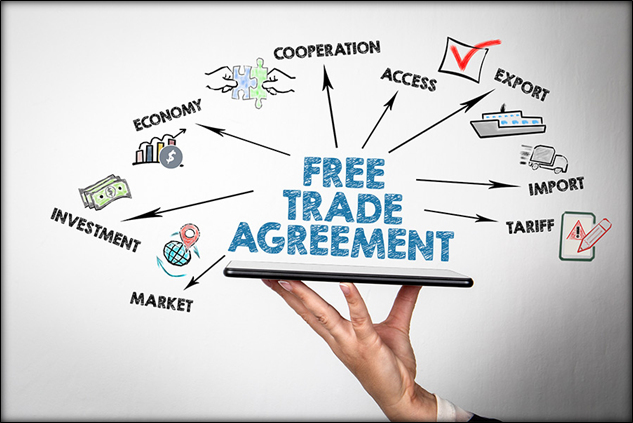
About Free Trade Agreements (FTAs)
- Definition: A treaty between two or more countries to reduce or eliminate tariffs, quotas, and trade barriers, enabling the free flow of goods, services, investments, and technology.
- Objectives: Expand export market access, enhance economic cooperation, stimulate investment flows, improve global competitiveness, and integrate domestic industries into global value chains (GVCs).
- Strategic Utility: India utilizes FTAs as a strategic instrument to boost exports, attract foreign investments, and diversify global supply chains.
India’s FTA Network Overview
- India’s FTA network currently encompasses 15 agreements covering 27 countries, including the recently operationalized India–Oman Comprehensive Economic Partnership Agreement (CEPA).
- Negotiations with several other major countries and trading blocs are nearing completion.
Key Dimensions of FTAs
- Trade Liberalisation: Reduction or elimination of customs duties on goods and services.
- Investment Facilitation: Promotion of cross-border investments via stable and predictable regulatory rules.
- Services Trade: Enhanced market access and professional mobility in sectors such as IT, finance, and healthcare.
- Rules of Origin (RoO): Criteria determining whether a product qualifies for preferential tariff treatment.
- Supply Chain Integration: Facilitation of domestic participation in regional and global value chains.
- Strategic Cooperation: Strengthening of economic diplomacy and geopolitical partnerships.
India’s FTAs with Countries and Regional Groupings
- ASEAN-India FTA: Trade in goods, services, and investment with Southeast Asian nations.
- India-Japan CEPA: Tariff reduction, services access, and investment cooperation.
- India-South Korea CEPA: Enhanced trade in manufacturing and technology sectors.
- India-Singapore CECA: Focus on trade, services, and financial cooperation.
- India-UAE CEPA: Boosts bilateral trade and logistics connectivity.
- India-Australia ECTA: Greater access for Indian goods, students, and professionals.
- India-Mauritius CECPA: Trade and investment facilitation.
- India-EFTA TEPA: Covers Switzerland, Norway, Iceland, and Liechtenstein with binding investment commitments.
- India-Oman CEPA: Expands market access and economic cooperation in goods and services.
- Ongoing Negotiations: European Union (EU), United Kingdom (UK), Gulf Cooperation Council (GCC), Peru, Israel, and others.
- Future Projection: Once ongoing negotiations conclude, FTA partners could account for nearly 75% of India’s total exports.
Conclusion
- FTAs remain a crucial pillar of India’s economic strategy, but challenges like rising deficits, low utilisation rates, inverted duty structures, and manufacturing relocation demand precise policy calibration.
- A balanced approach integrating global market access with robust domestic industrial competitiveness is essential to ensure FTAs actively contribute to Atmanirbhar Bharat, Make in India, and the aspiration of becoming a global manufacturing powerhouse.
| This Concept Has Been Covered In This Article: The Strategic Blueprint of the India-New Zealand Free Trade Agreement |