
Context
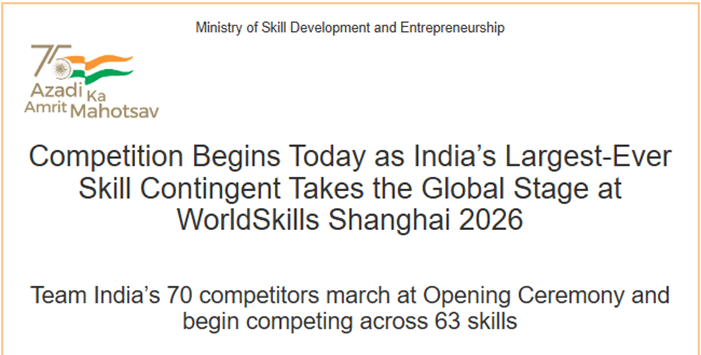
- Recently, India has participated in WorldSkills Shanghai 2026 with its largest-ever contingent of 70 competitors, competing across 63 skill categories, highlighting India’s growing focus on vocational education, technical skills and global workforce competitiveness.
About WorldSkills Competition
- The WorldSkills Competition is the world’s largest international platform for vocational education, training and skills excellence.
- It is organised every two years by WorldSkills International.
- It provides young professionals an opportunity to demonstrate:
- Technical expertise
- Precision and craftsmanship
- Creativity and innovation
- Industry-relevant skills
- The competition enables participants to benchmark their skills against global standards.
WorldSkills Shanghai 2026
- Edition: 48th WorldSkills Competition.
- Venue: Shanghai, China.
- Indian Contingent: 70 competitors.
- The event brings together nearly 1,400 competitors from more than 65 countries and regions.
- WorldSkills Expo & Conference: Brings together youth, policymakers, educators and industry leaders to discuss the future of technical and vocational education and workforce development.
India’s Expanded Participation
India is participating in 11 new skill categories for the first time:
- Dental Prosthetics
- Digital Interactive Media Design
- Intelligent Security Technology
- Landscape Gardening
- Optoelectronic Technology
- Retail Sales
- Unmanned Aerial Systems
- Industrial Mechanics
- Software Testing
- Heavy Vehicle Technology
- Aircraft Maintenance
Institutional Framework
- India’s participation is supported by various stakeholders:
- Ministry of Skill Development and Entrepreneurship (MSDE)
- Directorate General of Training (DGT)
- National Skill Organization (NSO)
- Industrial Training Institutes (ITIs)
- Sector Skill Councils
- State Governments
- Industry partners
- Technical experts and mentors
Significance for India
- Global benchmarking: Assesses Indian vocational skills against international standards.
- Employability: Promotes industry-relevant technical and vocational skills.
- Skill ecosystem: Strengthens collaboration among government, industry, training institutions and experts.
- Youth empowerment: Provides young professionals with international exposure and recognition.
- Future-ready workforce: Encourages emerging skills linked to technology, automation and changing industry requirements.
Conclusion
WorldSkills Shanghai 2026 reflects India’s efforts to strengthen its vocational education and skill-development ecosystem and align its workforce with global skill standards. India’s expanded participation also highlights the growing importance of technical, digital and emerging skills in building a future-ready workforce.