
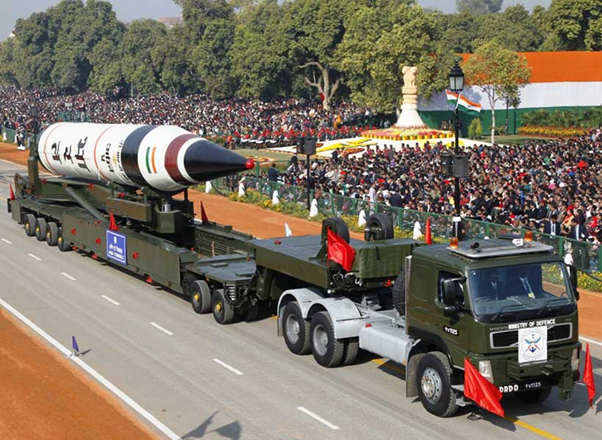
After Reading This Article You Can Solve This UPSC Mains Model Question:
Discuss the strategic implications of India’s recent operational deployment of nuclear warheads for its ‘No First Use’ (NFU) policy. 15 Marks (GS-3, Science & Technology)
Context
The SIPRI 2026 Yearbook reveals India has operationally deployed 12 of its 190 nuclear warheads for the first time. This shift to active deployment aboard ballistic missile submarines (SSBNs) signals heightened readiness while strictly maintaining the ‘No First Use’ policy.
Introduction
India is transitioning from a historically de-mated nuclear posture to active sea-based deployment. Equipping Arihant-class submarines with nuclear warheads mathematically secures India’s second-strike capability. This maturation of the nuclear triad practically fortifies the credibility of its deterrence doctrine against expanding regional arsenals.
What is India’s Nuclear Doctrine and its Core Principles?
1. No First Use (NFU) & Credible Minimum Deterrence
- India commits to never launching a pre-emptive nuclear strike.
- It relies on a limited but highly survivable arsenal to deliver a massive retaliatory response that inflicts unacceptable damage on the adversary.
2. Recessed Deterrent (De-mated Posture)
- A peacetime strategy where nuclear warheads are stored separately from their delivery vehicles.
- This is done under strict civilian oversight to maximize safety, prevent accidental use, and signal global restraint.
3. Operational Deployment & The Nuclear Triad
- Deployment means a weapon has been actively paired with a delivery system (like an SSBN) and positioned in a state of readiness.
- This completes the nuclear triad, solidifying the military capability to deliver atomic weapons via three distinct methods: aircraft, land-based missiles, and sea-based submarines.
Significance of Operational Deployment
1. Guaranteed Second-Strike Capability: Deployment on stealth submarines ensures that a significant portion of the nuclear arsenal survives a disarming first strike. This guarantees the ability to deliver a devastating retaliatory blow, the cornerstone of India’s deterrence.
2. Reinforcement of ‘No First Use’ : A doctrine relying on retaliation is only effective if the forces can survive an initial attack. Sea-basing solves this survivability problem, making the NFU commitment strategically credible rather than a liability.
3. Closing Land-Based Vulnerabilities : Land-based missiles sit at known and mappable locations, making them theoretically vulnerable to preemptive strikes. A submerged SSBN conducting a deterrence patrol in the ocean cannot be easily tracked or destroyed, closing this critical gap.
4. Strategic Counterbalance to China : China’s nuclear arsenal is expanding rapidly, currently estimated at 620 warheads, far outpacing regional neighbors. India’s SSBN deployment preserves strategic stability and credible deterrence against this expanding threat.
5. Maturation of the Nuclear Triad : The operationalization of tri-SSBNs marks the coming-of-age of India’s strategic forces. It confirms that India’s long-envisioned deterrent posture is now fully functional across land, air, and sea domains.
Challenges in the Global Strategic Environment
1. Collapse of Arms-Control Regimes : The post-Cold War nuclear order is experiencing severe strain globally. Traditional disarmament and arms-control agreements have systematically weakened or collapsed.
2. Rapid Adversarial Expansion : China’s nuclear arsenal is expanding at a pace unmatched by any other nuclear power. It is simultaneously aggressively expanding its sea-based nuclear deterrent capabilities.
3. Threat of Emerging Technologies : Intense global competition in artificial intelligence (AI) enabled decision support systems increases the risk of strategic miscalculation. The development of hypersonic delivery systems heavily compresses response times for national defense systems.
4. Advancements in Anti-Submarine Warfare (ASW) : Rapid developments in advanced ASW tracking and missile defense systems continue to evolve. These technologies continually threaten to compromise the stealth, secrecy, and survivability of sea-based deterrents.
5. Reversal of Global Disarmament : States are increasingly relying on nuclear weapons as active, deployable instruments of national power. This signals a dangerous reversal of decades of gradual global progress in nuclear disarmament.
Current Global Situation
1. The Expanding Global Arsenal : As of January 2026, the world’s nine nuclear-armed states collectively possess an estimated 12,187 nuclear warheads. This indicates a broader trend of nuclear modernization across all major powers.
2. China’s Modernization Drive : Beijing is heavily focused on developing long-range delivery systems and sea-based patrols. This unmatched expansion forces shifts in the deterrence postures of neighboring states, including India.
Way Forward
1. Sustain and Expand the SSBN Fleet : India must ensure a sufficient fleet size of Arihant-class submarines. This guarantees that at least one nuclear ballistic missile submarine is submerged and on deterrence patrol at all times.
2. Focus on Long-Range Delivery Systems : The strategic modernization program should prioritize land and sea-based systems capable of reaching diverse targets. This is essential for maintaining credible deterrence against larger adversarial territories.
3. Uphold Strict Civilian Oversight : Robust command and control mechanisms must be rigorously maintained over mated delivery systems. This ensures maximum operational readiness while eliminating the risk of accidental or unauthorized launches.
4. Invest in Counter-Technologies : Systematic investments are required in advanced stealth and acoustic countermeasures. This will protect Indian submarines from next-generation anti-submarine warfare tracking systems.
5. Enhance Strategic Communication : Policymakers must proactively communicate the defensive nature of these deployments to the international community. It must be clear that increased readiness does not imply a lowering of the threshold for nuclear employment.
6. Modernize Global Risk Frameworks : International institutions designed to manage nuclear risk must quickly adapt their frameworks. They need to effectively regulate the unprecedented risks posed by AI and hypersonic weaponry.
Conclusion
India’s deployment of 12 nuclear warheads is a necessary maturation of its credible minimum deterrence posture. By securing a highly robust second-strike capability through its SSBN fleet, India fortifies t he practical foundations of its ‘No First Use’ doctrine, ensuring national sovereignty and strategic stability in an increasingly volatile global environment.