
Context
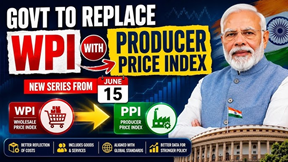
- The Ministry of Commerce and Industry is executing a major structural reform in India’s inflation-mapping architecture. Over the next five years, the traditional Wholesale Price Index (WPI) will be systematically phased out and entirely replaced by the globally standardized Producer Price Index (PPI).
1. The Transition Roadmap
To prevent economic disruptions, the Department for Promotion of Industry and Internal Trade (DPIIT) is executing a dual-track parallel release starting June 15:
- Base Year Revision: The temporary WPI series updates its base year from 2011-12 to 2022-23.
- The 5-Year Parallel Run: Because WPI is legally embedded in corporate and government price-escalation contracts, it will be published alongside the new PPI for five years. This allows commercial entities a smooth operational transition before WPI is permanently discontinued.
2. The New PPI Architecture
Unlike the single-metric approach of the wholesale index, the new PPI tracks price changes at different entry and exit points of production through three separate indices:
- Output PPI: Captures the average change in basic prices received by domestic producers when the finished goods leave the factory floor.
- Trial Input PPI: Measures the price fluctuations of raw materials and intermediate inputs as they enter the production pipeline.
- Services PPI: Brings the services economy into production-level inflation tracking for the first time.
Phase 1 Services Basket: The index initiates tracking across seven foundational service sectors: Banking, Securities Transactions, Insurance, Management of Pension Funds, Railways, Air (Passenger), and Telecom.
3. WPI vs. PPI
| Parameter | Wholesale Price Index (WPI) | Producer Price Index (PPI) |
| Core Measurement | Tracks price changes of goods traded in bulk at the wholesale level. | Tracks average change in prices received by domestic producers for their output/input. |
| Services Sector | Completely excluded. | Included (7 sectors in Phase 1, expanding later). |
| Global Alignment | Out of sync with advanced economies; criticized for omitting consumer-facing services. | Aligned with International Monetary Fund (IMF) best practices. |
| Margins & Taxes | Includes trade and transport margins between the producer and wholesaler. | Measures basic prices received by the producer, eliminating trade/transport distortions. |
4. About the WPI Framework
- Compiling Authority: Published on a monthly basis by the Office of the Economic Adviser, DPIIT, Ministry of Commerce and Industry.
- The Three Pillars of WPI Weightage:
- Manufactured Products (64.23%): The largest component, encompassing metals, chemicals, machinery, and textiles.
- Primary Articles (22.62%): Covers raw food items, non-food agricultural items, and crude petroleum.
- Fuel & Power (13.15%): Tracks corporate energy inputs like electricity, petrol, diesel, and LPG.
- The WPI Food Index: This is a distinct sub-index calculated by combining the weightage of ‘food articles’ from the Primary Articles group and ‘food products’ from the Manufactured Products group.
With respect to the transition from the Wholesale Price Index (WPI) to the Producer Price Index (PPI), consider the following statements:
I. The Wholesale Price Index completely excludes the services sector, whereas the newly introduced Producer Price Index integrates it.
II. The Producer Price Index measures the basic prices received by producers by including trade margins and transport costs.
Which of the statements given above is/are correct?
(a) I only
(b) II only
(c) Both I and II
(d) Neither I nor II
Answer: A
Explanation:
Statement I is Correct: The Wholesale Price Index (WPI) primarily tracks price changes in goods and does not cover the services sector. The proposed Producer Price Index (PPI) is intended to provide broader coverage and include services alongside goods, making it a more comprehensive measure of producer-level inflation.
Statement II is Incorrect: The Producer Price Index (PPI) measures the basic prices received by producers. These prices exclude trade margins, transport costs, and product taxes, as they are not part of the amount retained by the producer.