
Context
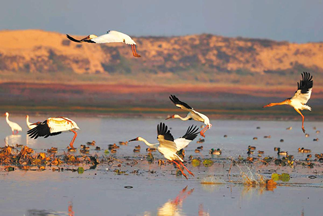
- Recently, Manasbal Lake in Jammu & Kashmir’s Ganderbal district witnessed the return of migratory birds following ecological restoration measures, signalling the revival of its biodiversity and ecological health.
Geographical & Physical Features of Mansbal Lake
- Location: Ganderbal District, Jammu & Kashmir.
- Deepest Freshwater Lake: It is recognized as the deepest freshwater lake in the country, reaching a maximum depth of 43 feet (approx. 13 meters).
- Dimensions: The lake measures roughly 3.5 km in length and 1.5 km in breadth.
- Hydrology & Mixing Type: Classified as a warm monomictic lake, it undergoes thermal stratification from March to November and circulates completely once a year. It lacks major surface inlet channels and is primarily sustained by internal springs and precipitation.
- Drainage: The surplus water drains out into the Jhelum River via an outlet channel.
Historical & Cultural Footprint:
- It features the ruins of Jharokha Bagh, a 17th-century Mughal garden built by Empress Nur Jahan.
- An ancient Hindu temple dating back to the 8th–9th century (Avantivarman era) was unearthed on its shores during restoration.
Avian Diversity & Ecological Recovery
- Often called the “Supreme Gem of all Kashmir Lakes” or “Bird’s Paradise,” the lake serves as a critical natural staging ground for aquatic birds.
- Diverse Inhabitants: It hosts more than 46 species of birds across 23 families.
- Key Migratory Species :
- Horned Grebe
- Long-Eared Owl
- White-Headed Duck
- Mallard
- Golden Eagle
- Eurasian Hoopoe, Lesser Pied Kingfisher, and Grey-Backed Shrike.
Threats & Mitigation Framework
- The lake has historically suffered from extensive eutrophication driven by excessive aquatic weeds (Ceratophyllum demersum), agricultural runoff, and waste accumulation, which severely impeded water circulation.
Restoration Measures
- De-weeding & Dredging: Managed by the Wular-Manasbal Development Authority (WMDA), massive clearing initiatives removed over 7,202 cubic meters of surface weeds and dredged an area of 70,000 square feet to restore depth and flow channels.
- Water Budgeting: Spearheaded by the J&K Water Resources Regulatory Authority to scientifically monitor carrying capacity, water drawls, and maintain the ecosystem’s baseline ecological health.
- Waste Management: Adoption of a three-pronged purification approach including a dedicated sewage treatment plant (STP) and an integrated solid waste management facility.
Consider the following statements regarding Manasbal Lake:
1. It is recognized as the deepest freshwater lake in India.
2. It is classified as a dimictic lake, meaning its water completely mixes twice a year due to seasonal temperature shifts.
3. The lake does not have any major surface inlet streams and is primarily fed by internal springs.
Which of the statements given above are correct?
A. 1 and 2 only
B. 2 and 3 only
C. 1 and 3 only
D. 1, 2, and 3
Answer: C. 1 and 3 only
• Statement 1 is correct: Manasbal Lake is recognized as the deepest natural freshwater lake in India, reaching a depth of approximately 43 feet (13 meters).
• Statement 2 is incorrect: It is a warm monomictic lake, not dimictic. Warm monomictic lakes undergo thermal stratification for most of the year (March to November) and circulate/mix completely only once a year during the winter.
• Statement 3 is correct: The hydrology of Manasbal Lake is unique because it lacks any major perennial surface inlet channels; its main source of water inflow comes from internal underwater springs and precipitation.