
Context
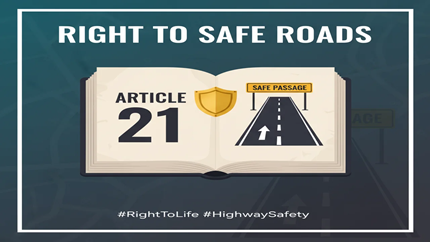
- Recently, the Supreme Court of India delivered a transformative ruling in a suo motu case, declaring that the right to safe travel on highways is an integral part of the Right to Life under Article 21 of the Constitution.
- The Bench, while adjudicating tragic road fatalities in Rajasthan and Telangana, observed that a road—particularly a high-speed expressway—must not become a “corridor of peril” due to administrative lethargy or infrastructural gaps. This judgment shifts road safety from a mere policy goal to a constitutionally mandated positive obligation of the State.
1. Constitutional Foundation
- Article 21 Expansion: The Court held that the Right to Life is not just a “negative right” (protection against unlawful killing) but a “positive mandate” for the State to ensure a safe environment.
- Doctrine of State Responsibility: When the State provides infrastructure like National Highways (NH), it is constitutionally bound to ensure that such infrastructure does not pose an avoidable threat to life.
2. The “2% vs. 30%” Paradox
- Statistical Reality: National Highways constitute approximately 2% of India’s total road network.
- Fatality Burden: Despite their small share in length, they account for nearly 30% of all road accident fatalities in the country.
- Economic Impact: Road accidents cost the Indian economy between 3% to 5% of its GDP annually, affecting the most productive age group (18–45 years).
3. Key Judicial Directives
The Supreme Court issued several nationwide interim directions to enhance accountability:
- Removal of Encroachments: Immediate prohibition and removal of unauthorized dhabas, eateries, or commercial structures within the Right of Way (ROW) of any National Highway.
- Strict Parking Norms: Heavy or commercial vehicles are prohibited from parking on the carriageway or paved shoulders; they must only use designated Truck Lay-byes or Wayside Amenities (WSAs).
- District-Level Accountability: Mandated the creation of a District Highway Safety Task Force headed by the District Magistrate (DM) and Superintendent of Police (SP) to ensure enforcement.
- Emergency Response: Deployment of ambulances and recovery cranes at regular intervals to utilize the “Golden Hour” (the first hour after injury when prompt medical care is most effective).
4. Technological Integration
- Advanced Traffic Management System (ATMS): The Court pushed for NHAI to operationalize ATMS, including speed sensors, CCTV surveillance, and emergency call boxes.
- Automatic Enforcement: Use of timestamped photographic evidence for generating integrated e-challans to eliminate human bias and corruption.
Q. Consider the following statements regarding the legal framework of Road Safety in India:
1. The Supreme Court has recognized the "Right to Safe Passage" on roads as a fundamental right derived from Article 21 of the Constitution.
2. In India, National Highways account for the majority of the total road length but a minority of road accident fatalities.
3. The "Golden Hour" refers to the time period during which a person injured in a road accident can be treated without being penalized for a lack of documentation under the Motor Vehicles (Amendment) Act.
Which of the statements given above is/are correct?
(a) 1 only
(b) 1 and 2 only
(c) 2 and 3 only
(d) 1 and 3 only
Solution: A
• STATEMENT 1 CORRECT: As per the recent April 2026 ruling, the SC explicitly linked safe passage to the Right to Life under Article 21.
• STATEMENT 2 INCORRECT: National Highways constitute only 2% of the total road length but account for a disproportionately high 30% of fatalities.
• STATEMENT 3 INCORRECT: While the "Golden Hour" is defined in the Motor Vehicles Act, it specifically refers to the one-hour time period following a traumatic injury during which there is the highest likelihood that prompt medical care will prevent death. The protection from legal/documentation hurdles for rescuers is part of the Good Samaritan guidelines, not the definition of the Golden Hour itself.