
Context
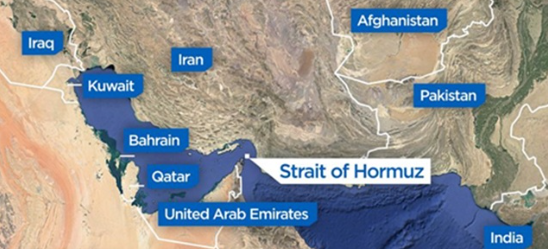
- Ahead of Prime Minister of India’s bilateral talks with French President at the G7 Summit, France has proposed a broader multinational maritime security partnership with India. This initiative aims to ensure maritime security and freedom of navigation in the geopolitically sensitive Strait of Hormuz amid rising regional tensions in West Asia.
Key Bilateral & Multilateral Highlights
- Proposed Participants: The West Asia-focused initiative, discussed on the margins of the G7 Summit, is expected to involve India, the United States, France, Qatar, Saudi Arabia, and the UAE.
- Core Agenda of India-France Talks: Defense cooperation, maritime security, military hardware acquisition, and geopolitical developments in West Asia.
Connected Initiatives
- Operation Sankalp: India’s own independent maritime security operation launched by the Indian Navy in 2019 in the Persian Gulf and the Gulf of Oman to ensure the safety of Indian flagged merchant vessels following security incidents in the region.
- EMASOH (European Maritime Awareness in the Strait of Hormuz): It is a French-led maritime monitoring mission with the goal to protect maritime flows through the Strait of Hormuz. It is headquartered at the French naval base in Abu Dhabi and comprises a diplomacy track (EMASoH) and a military track (AGENOR).
- Naval Exercise – VARUNA 2025: Exercise Varuna has evolved into a cornerstone of the India–France strategic partnership, enhancing cooperation in anti-submarine warfare, air defence, and surface combat operations.
About the Group of Seven (G7)
- What is it? The G7 is an informal bloc of industrialized, advanced economies that meet annually to discuss global economic governance, international security, and energy policy.
- Origin: Began in 1975 as the G6 (France, West Germany, Italy, Japan, the UK, and the US) in response to economic crises and the oil shock of the 1970s.
- Canada joined in 1976, creating the G7.
- Russia joined in 1997, forming the G8.
- Russia’s membership was suspended in 2014 following the annexation of Crimea, and the group returned to the G7 format.
- Institutional Setup: Crucially, the G7 does not have a permanent secretariat, a legal charter, or a formal treaty.
Consider the following statements:
1. The Strait of Hormuz connects the Persian Gulf with the Gulf of Oman and the Arabian Sea.
2. Operation Sankalp is a multinational maritime mission led by France to secure shipping lanes in the Strait of Hormuz.
3. European Maritime Awareness in the Strait of Hormuz was established with the objective of ensuring freedom of navigation and monitoring maritime activity in the Strait of Hormuz.
Which of the statements given above is/are correct?
(a) 1 and 3 only
(b) 2 and 3 only
(c) 1 only
(d) 1, 2 and 3
Answer: (a) 1 and 3 only
Explanation:
• Statement 1 is correct: The Strait of Hormuz is a strategic chokepoint linking the Persian Gulf to the Gulf of Oman and the Arabian Sea.
• Statement 2 is incorrect: Operation Sankalp is an Indian Navy operation, not a French-led multinational mission.
• Statement 3 is correct: EMASOH was established to safeguard maritime flows and enhance maritime situational awareness in the Strait of Hormuz.