
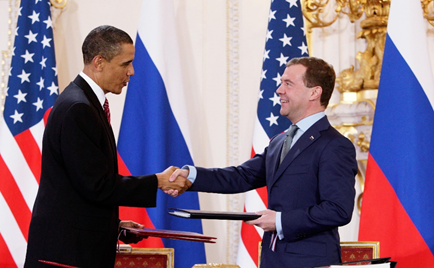
Strategic Arms Reduction Treaty (START) (What is it?)
- The Strategic Arms Reduction Treaty (START I) was a bilateral arms control agreement between the United States and the Soviet Union, aimed at reducing their strategic nuclear arsenals.
- It was signed on July 31, 1991, and entered into force on December 5, 1994, following the dissolution of the Soviet Union.
- It was the first legally binding agreement to reduce the strategic offensive nuclear arsenals of the two superpowers.
- The treaty established limits on nuclear warheads, intercontinental ballistic missiles (ICBMs), submarine-launched ballistic missiles (SLBMs) and heavy bombers.
- It introduced extensive verification mechanisms, including on-site inspections, data exchanges and monitoring.
Objectives of START (Why is it important?)
1. Nuclear Arms Reduction: Reduce the strategic nuclear arsenals of the U.S. and Russia to prevent an uncontrolled arms race.
2. Strategic Stability: Reduce the possibility of nuclear confrontation through mutually agreed limits.
3. Transparency and Verification: Establish monitoring and inspection mechanisms to build confidence between nuclear powers.
4. Arms Control Cooperation: Promote diplomatic engagement and reduce Cold War-era nuclear rivalry.
Key Features of START
1. Reduction of Nuclear Arsenals
- Required both sides to reduce their accountable strategic nuclear warheads to 6,000.
- Limited strategic nuclear delivery vehicles to 1,600.
- Covered ICBMs, SLBMs and heavy bombers.
2. Verification Mechanism
- Provided for on-site inspections and monitoring of nuclear facilities.
- Required regular exchange of data on nuclear weapons and delivery systems.
- Established procedures to verify compliance with treaty obligations.
3. Bilateral Agreement
- Initially signed between the U.S. and the Soviet Union.
- Following the dissolution of the Soviet Union, Russia, Belarus, Kazakhstan and Ukraine became involved in the implementation framework.
- Belarus, Kazakhstan and Ukraine subsequently transferred the nuclear weapons on their territories out of their possession.
4. Expiry of START I
- Entered into force in 1994 and expired on December 5, 2009.
- It was succeeded by the New START Treaty (2010) between the U.S. and Russia.
5. New START Treaty (2010) – Successor Framework
- Signed on April 8, 2010, and entered into force on February 5, 2011.
- Limited each country to:
- 1,550 deployed strategic nuclear warheads.
- 700 deployed ICBMs, SLBMs and heavy bombers.
- 800 deployed and non-deployed launchers and heavy bombers.
- Extended for five years in 2021 and expired on February 5, 2026.
- Its expiry ended the last major bilateral treaty framework imposing legally binding limits on U.S. and Russian strategic nuclear arsenals.
Conclusion
START marked a significant milestone in nuclear arms control by transforming strategic rivalry into a framework of negotiated reductions and verification. However, the expiry of New START in 2026 highlights the weakening of the global arms control architecture and the need for renewed international cooperation to prevent a nuclear arms race.
| This Concept has been discussed in the following article: Nuclear Risk Reduction: Need for a New Global Arms Control Framework |