
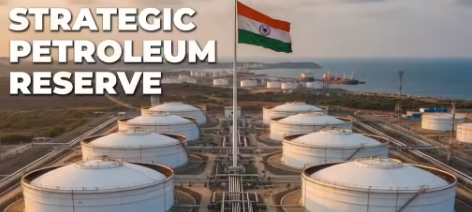
Context
- Amidst escalating geopolitical tensions in West Asia, the Government of India recently reviewed the country’s energy preparedness. The government has reassured that India maintains a robust cushion with 60 days of crude oil reserves, 60 days of natural gas, and 45 days of LPG rolling stock, supported by a strong Foreign Exchange (Forex) reserve of approximately $703 billion (as of early 2026).
1. India’s Strategic Petroleum Reserve (SPR) Programme
The SPR programme was conceptualized to safeguard the nation against external supply shocks, inspired by the 1991 Gulf War crisis.
I. Institutional Framework
- Managing Entity: The reserves are managed by Indian Strategic Petroleum Reserves Limited (ISPRL).
- Nature of Entity: ISPRL is a Special Purpose Vehicle (SPV) and a wholly-owned subsidiary of the Oil Industry Development Board (OIDB) under the Ministry of Petroleum & Natural Gas.
- Storage Technology: Crude oil is stored in massive underground unlined rock caverns, which are safer and more cost-effective than above-ground tanks.
2. Phase-wise Development
| Phase | Location | State |
| Phase I | Visakhapatnam | Andhra Pradesh |
| Mangaluru | Karnataka | |
| Padur | Karnataka | |
| Phase II | Chandikhol | Odisha |
| Padur (Expansion) | Karnataka |
3. Important Points
- IEA Standards: The International Energy Agency (IEA) recommends member countries hold emergency oil stocks equivalent to at least 90 days of net imports. India, an associate member, is moving towards this benchmark.
| About IEA It is an autonomous intergovernmental organization established in 1974, headquartered in Paris, France, to ensure reliable, affordable, and clean energy. It operates within the framework of the Organization for Economic Co-operation and Development (OECD). Key Publications: World Energy Outlook, World Energy Investment, Net Zero by 2050. Membership: Full membership was historically open only to OECD nations. IEA currently has 32 full members. Association Countries: 13 countries, including India, China, Brazil, and South Africa. These countries participate in discussions but lack decision-making rights. |
4. Oil Reserve Storage: USA vs India
- The United States stores its Strategic Petroleum Reserve (SPR) in underground salt caverns created inside naturally occurring salt domes.
- These caverns are located mainly along the Gulf Coast in states like Texas and Louisiana.
- The U.S. has the world’s largest SPR capacity.
- In India: Uses engineered hard rock caverns beneath the ground.
With reference to the International Energy Agency (IEA), consider the following statements:
1. It was established in 1974 and is headquartered in Paris.
2. It operates within the framework of the OECD.
3. India is a full member of the IEA with voting rights.
Which of the statements given above is/are correct?
A. 1 and 2 only
B. 2 and 3 only
C. 1 only
D. 1, 2 and 3
Answer: A
Explanation:
•  Statement 1 is correct: The International Energy Agency (IEA) was established in 1974 in the aftermath of the global oil crisis and is headquartered in Paris, France.
•  Statement 2 is correct: The IEA functions within the institutional framework of the Organisation for Economic Co-operation and Development (OECD).
•  Statement 3 is incorrect: India is not a full member of the IEA. India is an Association Country, which allows participation in discussions and cooperation, but without formal decision-making or voting rights.