
Context
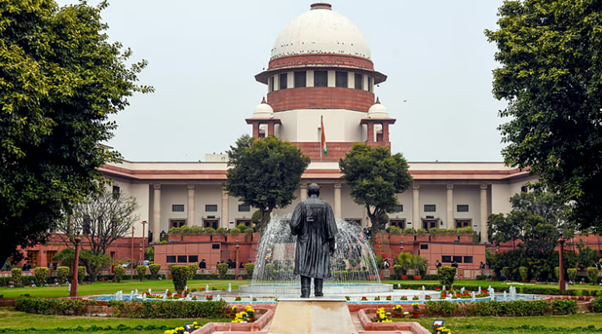
The Supreme Court has ruled that the PMLA Adjudicating Authority must have at least one judicial member on its Bench while deciding whether a property is involved in money laundering and confirming its attachment. The judgment highlights the need for judicial expertise, legal objectivity and procedural fairness while exercising the State’s power to attach property even before an individual’s guilt is established.
Supreme Court’s Key Observations
- Judicial Member Mandatory: Every Bench undertaking final adjudication under Sections 8(2) and 8(3) must include a judicial member.
- Single-Member Bench: A single-member Bench can undertake final adjudication, provided that the member is a judicial member.
- Show-Cause Notice: The issuance of a show-cause notice under Section 8(1) does not require the presence of a judicial member.
- Role of Chairperson: The Chairperson of the Adjudicating Authority is not necessarily required to be a judicial member.
- Reason for the Decision: Final adjudication involves interpreting legal provisions, examining evidence and determining property rights. Therefore, judicial expertise is necessary to ensure legal objectivity.
- 2009 Amendment: The Court recommended that the Union Government consider repealing the 2009 amendment and restoring the original framework of multiple Adjudicating Authorities to reduce the burden on a single authority.
Important Concepts Related to PMLA
1. Money Laundering
- Definition: Concealing illegally obtained money and projecting it as legitimate wealth.
- Stages: Placement (introducing money into the financial system), Layering (hiding its source through transactions) and Integration (reintroducing it as legitimate wealth).
2. Proceeds of Crime
- Section 2(1)(u): Property obtained directly or indirectly from criminal activity relating to a scheduled offence.
- Nature: Includes movable, immovable, tangible and intangible property.
3. Provisional Attachment
- Section 5: ED can temporarily attach suspected proceeds of crime, subject to statutory conditions.
- Purpose: Prevents the transfer or disposal of suspected illegal assets.
- Section 8: The Adjudicating Authority examines and decides whether attachment should be confirmed.
4. Adjudicating Authority
- Section 6: Provides for its establishment and composition.
- Composition: A Chairperson and two other members with relevant legal, administrative or financial expertise.
- Judicial Requirement: A judicial member must be present during final adjudication under Sections 8(2) and 8(3), as per the Supreme Court.
5. Principles of Natural Justice
- Meaning: Basic principles ensuring fairness in decision-making.
- Key Principles: Right to be heard, absence of bias and reasoned decisions.
- Significance: Protects individual rights and ensures procedural fairness in quasi-judicial proceedings.
| Important CTC from this Article: Prevention of Money Laundering Act (PMLA), 2002 |
                                            MCQ


Q. Consider the following statements regarding the Prevention of Money Laundering Act (PMLA), 2002:

1. The Enforcement Directorate is responsible for investigating offences under the PMLA.
2. The Adjudicating Authority can confirm the attachment of property without providing an opportunity of hearing to the affected person.
3. The Supreme Court has held that a judicial member must be present on the Bench undertaking final adjudication under Section 8 of the PMLA.
4. The 2009 amendment to the PMLA replaced the provision for multiple Adjudicating Authorities with a single Adjudicating Authority.

Which of the statements given above are correct?

(a) 1 and 2 only
(b) 1, 3 and 4 only
(c) 2 and 3 only
(d) 1, 2, 3 and 4

Correct Answer: (b) 1, 3 and 4 only

Explanation:
• Statement 1 is correct: The Enforcement Directorate (ED), under the Department of Revenue, Ministry of Finance, investigates money-laundering offences under the PMLA.
• Statement 2 is incorrect: Section 8(2) requires the Adjudicating Authority to consider the reply, hear the affected person and the authorised ED representative, and examine relevant material before passing its order.
• Statement 3 is correct: The Supreme Court has ruled that a judicial member must be part of the Bench undertaking final adjudication under Sections 8(2) and 8(3).
• Statement 4 is correct: The Prevention of Money Laundering (Amendment) Act, 2009 replaced the provision for appointing multiple Adjudicating Authorities with a single Adjudicating Authority.


                                     PYQ (1996)


Q. Hawala transactions relate to payments:

(a) Received in rupees against overseas currencies and vice versa without going through the official channels.
(b) Received for sale/transfer of shares without going through the established stock exchanges.
(c) Received as commission for services rendered to overseas investors/buyers/sellers in assisting them to get over the red tape and/or in getting preferential treatment.
(d) Made to political parties or to individuals for meeting election expenses.