
After reading this article you can answer this UPSC model question
Maritime governance is emerging as a key pillar of regional security in the Indo-Pacific. Discuss the strategic significance of India’s SHANTI initiative in addressing both traditional and non-traditional maritime security challenges. (15 Marks, GS2 Mains International Relation)
Why is in news
The article discusses the Bay of Bengal as India’s “SHANTI” anchor, arguing that the Bay of Bengal should evolve from merely a maritime space into a regional governance framework. It highlights the Bay of Bengal’s strategic importance amid intensifying Indo-Pacific geopolitical competition, maritime security challenges, and the need for institutional cooperation among littoral states.
Introduction
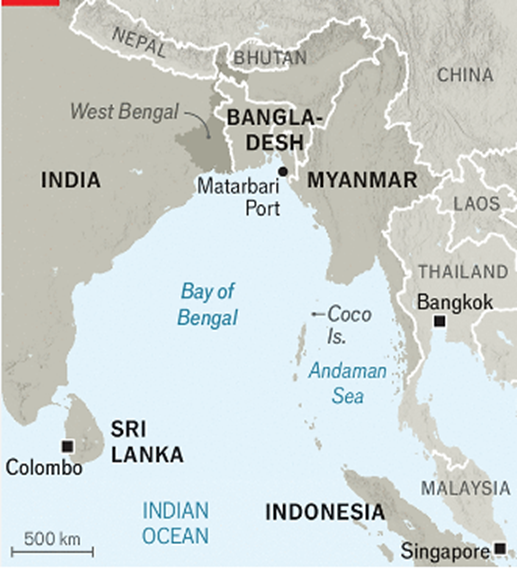
- The Bay of Bengal has emerged as the geostrategic heart of the Indo-Pacific, connecting the Indian Ocean with Southeast Asia and serving as the maritime lifeline for nearly one-fourth of the world’s population.
- With increasing geopolitical rivalry, China’s growing maritime footprint, climate-induced disasters, piracy, illegal fishing, and supply chain vulnerabilities, India is attempting to transform the Bay from a zone of strategic competition into a zone of cooperative security through its evolving maritime doctrine—SHANTI (Security through Advanced Maritime Governance and Robust Integration and Trust).
What is SHANTI?
- SHANTI (Security through Advanced Maritime Governance and Robust Integration and Trust) is India’s emerging maritime governance philosophy aimed at transforming the Bay of Bengal into a cooperative maritime security community.
- It seeks to integrate Maritime security, Economic connectivity, Disaster resilience, Blue Economy, Environmental sustainability, Institutional governance.
- Thus, SHANTI is not merely a security doctrine but a comprehensive maritime governance framework.
Why is the Bay of Bengal Strategically Important?
1. Gateway between the Indian and Pacific Oceans
- The Bay forms India’s maritime bridge with ASEAN, Indo-Pacific,East Asia and Western Pacific
2. Maritime Trade Hub
- Nearly 90–95% of India’s trade by volume and around 70% by value moves through the sea.
- The Bay facilitates Energy imports, LNG transportation, Global supply chains any disruption directly affects India’s economy.
3. Energy Security
- Critical sea routes transport Crude oil, LNG, Fertilizers, Coal, Strategic minerals. Hence maritime security equals energy security.
4. Strategic Military Importance
- The Bay hosts India’s Eastern Naval Command (Visakhapatnam), Andaman & Nicobar Command (India’s only tri-service command), Access to Malacca Strait
- It enables India to monitor Chinese naval movements across the eastern Indian Ocean.
5. Centre of Indo-Pacific Competition
- Major powers are increasing their presence China, United States, Japan, Australia, France.
- The Bay has become a theatre where geopolitical competition intersects with economic connectivity.
6. Climate Vulnerability
- The Bay witnesses Cyclones, Storm surges, Coastal erosion, Sea-level rise, Flooding, Saltwater intrusion.
- Regional cooperation is essential for disaster preparedness.
Evolving pattern of India’s initiative on maritime security
| Phase | Maritime Vision | Objective |
| 2015 | SAGAR | Security and Growth for All in the Region |
| 2019 onwards | Indo-Pacific Oceans Initiative (IPOI) | Rules-based maritime cooperation |
| 2025 | MAHASAGAR | Mutual and Holistic Advancement for Security and Growth Across Regions |
| Emerging | SHANTI | Advanced Maritime Governance and Trust-based Regional Integration |
Strategic Importance of SHANTI for India
Strengthens India’s Indo-Pacific leadership
India positions itself as a net security provider rather than merely a military power.
Counters China’s Maritime Expansion
China’s increasing naval deployments and infrastructure development under the Maritime Silk Road have enhanced its presence in the Bay.
SHANTI offers a cooperative, rules-based alternative focused on partnerships instead of power projection.
Enhances Maritime Domain Awareness (MDA)**
Improved information sharing enables:
- monitoring of shipping,
- detection of illegal activities,
- enhanced coastal security.
Supports Act East Policy
The Bay serves as the maritime bridge connecting India with ASEAN and the wider Indo-Pacific.
Secures Critical Sea Lanes
Protecting SLOCs ensures uninterrupted trade and energy supplies.
Potential Opportunities of SHANTI
1. Economic Integration
- SHANTI can promote regional value chains, port-led industrialization, logistics corridors, digital maritime trade.
2. Expansion of Blue Economy
- Potential sectors include Offshore wind energy, Ocean thermal energy, Aquaculture, Marine biotechnology, Cruise tourism.
- Deep-sea mining (subject to environmental safeguards)
3. BIMSTEC Revitalisation
- The Bay provides an opportunity to transform BIMSTEC into a security platform, an economic corridor, a connectivity hub.
4. Climate Leadership
- India can emerge as a leader in climate adaptation, coastal resilience, disaster management,
5. Defence Diplomacy
- Greater cooperation through MILAN naval exercise, coordinated patrols, HADR missions, coast guard cooperation, and naval training.
6. Strategic Supply Chains
- The Bay can become a resilient manufacturing and logistics hub under initiatives such as Indo-Pacific Economic Framework (IPEF), India-Middle East-Europe Economic Corridor (IMEC) linkages, Global supply chain diversification.
Challenges to SHANTI
- Strategic rivalry among major powers regarding China’s expanding maritime presence and dual-use port infrastructure.
- Weak institutional capacity of regional organizationsand maritime boundary disputes.
- Climate change and extreme weather events.
- Limited interoperability among regional navies.
Way Forward
- Institutionalise SHANTI through BIMSTEC with a dedicated maritime governance framework.
- Accelerate regional connectivity via Sagarmala, Kaladan Multimodal Transit Transport Project, and the India–Myanmar–Thailand Trilateral Highway.
- Promote a sustainable Blue Economy with marine conservation, pollution control, and resilient fisheries.
- Strengthen regional disaster management with integrated early warning systems and joint response protocols.
- Uphold UNCLOS, freedom of navigation, and peaceful dispute resolution to reinforce a rules-based maritime order.
- Foster collaboration with ASEAN, IORA, QUAD partners, and other Indo-Pacific stakeholders while preserving strategic autonomy.
Conclusion
- The Bay of Bengal is no longer a peripheral maritime space but the strategic centre of the Indo-Pacific, where economic connectivity, geopolitical competition, climate resilience, and maritime security converge.
- India’s proposed SHANTI framework represents an evolution from traditional naval security to inclusive maritime governance, integrating security, trust, sustainability, and institutional cooperation.