
After Reading This Article You Can Solve This UPSC Mains PYQ (2012)
“The situation today is far different to that prevalent fifty years back when the Indus Water Treaty was signed.” Highlight the complexity of the current challenges on both sides of the border in this regard. Do you think that a review of the Treaty is in India’s best interests? 15 marks (GS-2, International Relation)
Context
- India’s transboundary water strategy has shifted from historic strategic restraint to a security-linked enforcement framework under the IWT.
- Persistent cross-border terrorism, culminating in the Pahalgam attack, prompted India to place the treaty “in abeyance” after Pakistan ignored formal notices in 2023 and 2024 to modify the outdated 1960 pact.
Introduction
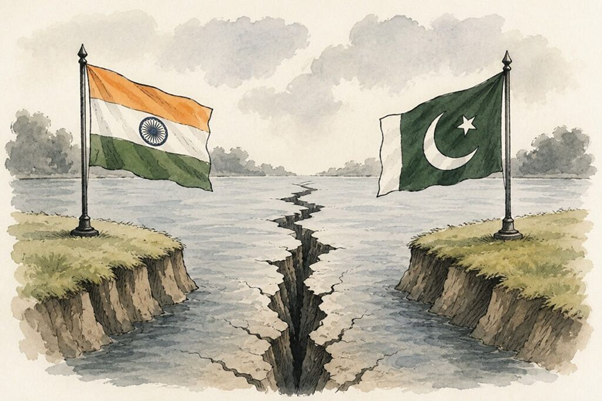
India’s suspension of the Indus Waters Treaty (1960) marks a significant shift by linking transboundary water governance with national security concerns. While it enhances India’s strategic leverage over the Western rivers, it also raises important legal, diplomatic, and geopolitical questions regarding the future of shared river management in South Asia.
What is the Indus Waters Treaty?
- A landmark transboundary water-sharing agreement signed in Karachi on September 19, 1960, brokered by the World Bank.
- It partitions the Indus Basin by granting India full rights over the Eastern Rivers (Ravi, Beas, Sutlej) and allocating the Western Rivers (Indus, Jhelum, Chenab) to Pakistan.
- India is permitted restricted “run-of-the-river” usage on the Western rivers for domestic consumption, agriculture, and hydropower generation subject to rigid specifications.
- It establishes a permanent bilateral institutional channel called the Permanent Indus Commission (PIC) composed of high-level commissioners from both states.
Legal Architecture of the Indus Waters Treaty
- Governed strictly by its text, Article XII(3) explicitly permits modification of treaty provisions “from time to time” but mandates another formal government-level treaty.
- The legal framework is perpetual, containing no unilateral exit clause or internal revival mechanisms should a party suspend execution.
- Features a rigid, three-tiered dispute resolution structure rising from Questions (handled by the PIC) to Differences (Neutral Expert) and Disputes (Court of Arbitration).
- Pakistan lacks external legal recourse to enforce compliance because of India’s operational reservations under the International Court of Justice (ICJ) statute.
Significance of the IWT Suspension
- Strategic Leverage Over Cross-Border Terror: It explicitly establishes a new national security doctrine that “blood and water cannot flow together,” making resource sharing conditional on peace.
- Unshackled Infrastructure and Hydropower Development: India gains complete design flexibility to construct extensive run-of-the-river projects and dams on the Jhelum and Chenab without Pakistani technical vetos.
- Enhanced Regional Flood and Water Management: Suspension allows India to implement unrestrained storage and water control measures to safeguard the flood-vulnerable Kashmir Valley.
- Information and Hydrological Data Dominance: Ceasing the mandatory monthly exchange of hydrological flow data directly hampers Pakistan’s monsoon planning and agricultural flood preparedness.
- Dismantling a Rigid, Non-Ecological Partition Model: The move breaks a static 1960 framework that completely ignores climate change impacts, environmental flows, and shared transboundary groundwater resources.
Challenges Associated with the IWT Suspension
- Critical Infrastructure and Engineering Deficits: India currently lacks the required diversion canals and storage reservoirs to immediately halt or re-route massive volumes of the Western rivers.
- Severe Humanitarian and Economic Fallout Downstream: Disrupting a basin that feeds 80% of Pakistan’s agriculture risks triggering catastrophic food insecurity and severe urban water shortages.
- Risk of Asymmetric or Military Escalation: Weaponizing a life-sustaining resource could push a water-stressed neighbor toward asymmetric gray-zone conflicts or direct border confrontations.
- International Diplomatic Scrutiny and Reputational Risks: Bypassing a historic, World Bank-brokered treaty may generate friction with global stakeholders and alter perceptions of India as a responsible upper riparian state.
- Complex International Legal Deadlock: Stepping outside a treaty lacking an exit clause leaves no orderly legal pathway or off-ramp, complicating long-term regional diplomacy.
Way Forward
- Accelerate Domestic Water Infrastructure Projects: Fast-track the funding and construction of long-delayed domestic storage structures, canals, and hydroelectric stations to fully capture permissible river waters.
- Formulate a Climate-Resilient Integrated Strategy: Incorporate advanced research, like IIT Gandhinagar’s basin data, into regional plans to handle the 20% drop in Eastern basin rainfall.
- Establish Strict Security Thresholds for Future Dialogue: Outline clear, conditional terms under which India will engage with the PIC, ensuring verifiable action against terror infrastructure precedes talks.
- Strengthen Center-State Collaborative Water Planning: Foster seamless institutional linkages between the Union government and riparian states like Punjab and Jammu & Kashmir to maximize resource allocation.
- Launch Proactive Global Diplomatic Outreach: Deploy targeted diplomatic communications to brief global partners and the World Bank, clearly contextualizing the suspension as a security necessity.
- Implement Strict Domestic Environmental Safeguards: Enforce robust local standards on sewage treatment and pollution control to prevent environmental degradation of rivers flowing through Indian territory.
Conclusion
The suspension of the Indus Waters Treaty reflects India’s shift towards linking water governance with national security. Going forward, India must complement its strategic leverage with stronger water infrastructure, climate-resilient management, and responsible diplomacy to safeguard both national interests and regional stability.