
Context
Magnetic levitation (maglev) technology is garnering renewed international attention as nations increasingly evaluate high-speed transit systems that utilize magnetic fields for levitation and propulsion, enabling operational speeds in excess of 400 km/hr.
About the Technology
- Maglev means “magnetic levitation.” These trains float above the track using magnetic force instead of wheels, so there’s no rolling friction. This lets them run at speeds over 400 km/hr. But building and running dedicated magnetic tracks needs precise engineering, making it expensive.
- Two fundamental forces are at play in a maglev system: the electromagnetic force and gravity; gravity is by far the weaker force, at roughly 10³⁹ times weaker than electromagnetism.
Key Features of Maglev Technology
How is a Train Lifted?
- EMS (Electromagnetic Suspension): Electromagnets pull the train up to hover 8–10 mm above the track; used in Shanghai Maglev (~500 km/hr).
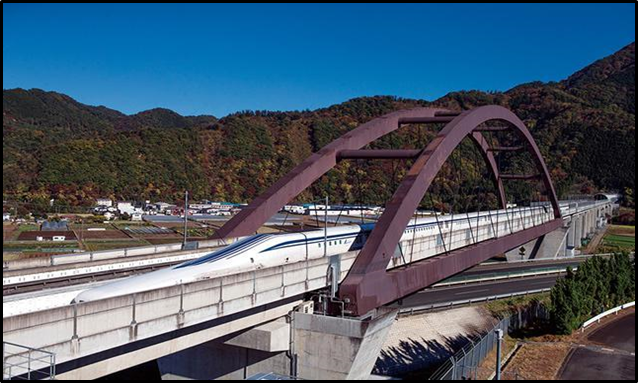
- EDS (Electrodynamic Suspension): Superconducting magnets induce current in guideway coils, pushing the train up; needs wheels till 100 km/hr. Japan’s SC Maglev hit 603 km/hr in 2015.
How Does the Train Move Forward?
- Guideway coils carry AC, switching poles to pull the train forward and push it from behind.
- Current controls speed; regenerative braking slows the train, with wheels /friction brakes kept for emergencies.
What are the Downsides of Maglev?
- No rolling friction → high aerodynamic resistance, needing costly designs (e.g., bird-beak-shaped front).
Uses of Maglev Technology in Other Sectors
- Turbines/compressors: magnetic bearings replace mechanical ones, reducing friction.
- Aircraft carriers: linear motor technology launches aircraft off decks.
- Factory automation: used in semiconductor manufacturing, CNC machining, and laser/X-ray/DNA-sequencing systems.
- Scientific research: magnetic fields levitate biological samples, liquids, metals, and small organisms.
Strategic/Scientific Significance
- Reinforces India’s interest in high-speed rail alternatives amid rising mobility demand, while showcasing electromagnetic principles’ cross-sector relevance to manufacturing, aerospace, and precision instrumentation.
| About Diamagnetic Levitation Diamagnetic Levitation: In 1997, Andre Geim and Michael Berry levitated a live frog using a 10-tesla magnetic field, earning the Ig Nobel Prize (2000); Geim later won the actual Nobel Prize in Physics for unrelated work on graphene. |
Q. With reference to magnetic levitation (maglev) technology, consider the following statements:
I. In Electrodynamic Suspension (EDS) systems, the train requires wheels for support until it reaches a minimum speed at which the levitation force overcomes gravity.
II. Electromagnetic Suspension (EMS) systems can levitate a train even when it is stationary.
III. Andre Geim and Michael Berry were jointly awarded the Nobel Prize in Physics for levitating a frog using a magnetic field.
Which of the statements given above is/are correct?
(a) I and II only
(b) II and III only
(c) I and III only
(d) I, II and III
Answer: (a) I and II only
Explanation:
Statement I is Correct: EDS systems rely on induced currents generated only once the train is moving, so wheels support the train until roughly 100 km/hr is reached.
Statement II is Correct: EMS systems use electromagnets that are attracted to the guideway regardless of motion, allowing levitation even at a standstill.
Statement III is Incorrect: Geim and Berry received the Ig Nobel Prize (2000) for the frog levitation experiment; Andre Geim's actual Nobel Prize in Physics was awarded separately for his work on graphene.