
Context
- Recently, India and New Zealand officially signed a landmark Free Trade Agreement (FTA) in New Delhi, which aims to provide Indian exporters with 100% duty-free access to the New Zealand market.
- This development follows a series of high-speed negotiations and joins a string of recent economic pacts, including the India-UK Comprehensive Economic and Trade Agreement (CETA) and the India-Oman CEPA, reflecting India’s aggressive “position of strength” in global trade as noted by the Prime Minister.
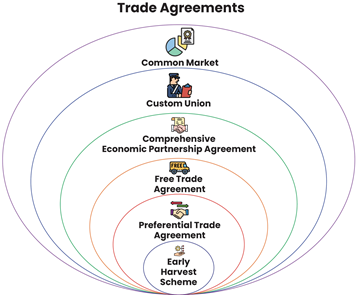
1. Preferential Trade Agreement (PTA)
- Nature: The most basic form of trade agreement.
- Mechanism: Two or more partners agree to reduce (not necessarily eliminate) customs duties on a limited number of products (Positive List).
- Key Detail: Only those goods listed in the agreement receive preferential treatment.
2. Free Trade Agreement (FTA)
- Nature: A more comprehensive arrangement than a PTA.
- Mechanism: Member countries eliminate or significantly reduce tariffs on a majority of goods traded between them.
- Key Detail: Unlike a Customs Union, member countries in an FTA maintain their own individual tariff rates for non-member countries.
- Recent Example: The India-New Zealand FTA (2026) and the India-EFTA TEPA.
3. Comprehensive Economic Cooperation Agreement (CECA)
- Nature: Covers a broader scope beyond just trade in goods.
- Mechanism: Includes trade in services, investment, and often economic cooperation.
- Focus: It primarily focuses on tariff negotiations and liberalizing trade in services.
- Example: India-Singapore CECA.
4. Comprehensive Economic Partnership Agreement (CEPA)
- Nature: The most advanced form of bilateral/regional pact that India signs.
- Mechanism: It is more exhaustive than CECA. It covers trade in goods, services, investment, Intellectual Property Rights (IPR), competition, and even government procurement.
- Example: India-UAE CEPA and the recently signed India-Oman CEPA.
5. Customs Union
- Nature: A higher stage of integration.
- Mechanism: Member countries eliminate internal barriers to trade AND adopt a Common External Tariff (CET) for non-members.
- Example: Southern African Customs Union (SACU).
6. Common Market
- Nature: Deep integration of factors of production.
- Mechanism: A Customs Union that also allows the free movement of labor and capital among member nations.
- Example: The European Union (EU) in its earlier stages.
7. Economic Union
- Nature: Near-total integration.
- Mechanism: A Common Market with harmonized economic policies, common fiscal and monetary policies, and often a common currency.
- Example: The European Union.
The “New-Age” Pacts (Signed/Concluded 2022–2026)
These agreements are comprehensive, covering not just goods, but also services, digital trade, and investment commitments.
| Agreement | Partner Country/Bloc | Status (as of April 2026) |
| India-EU FTA | European Union (27 nations) | Concluded Jan 2026; Internal ratification ongoing. |
| India-UK FTA | United Kingdom | Signed; Operational by May 1, 2026. |
| India-EFTA TEPA | Switzerland, Norway, Iceland, Liechtenstein | In Force (Effective Oct 1, 2025). |
| India-Oman CEPA | Oman | Signed Dec 2025; Implementation underway. |
| India-New Zealand FTA | New Zealand | Announced Dec 2025; Focused on services & dairy safeguards. |
| India-Australia ECTA | Australia | In Force (Since Dec 2022; Currently upgrading to CEPA). |
| India-UAE CEPA | United Arab Emirates | In Force (Since May 2022). |
| India-Mauritius CECPA | Mauritius | In Force (Since April 2021). |
Major Established Agreements (Early Phase)
These primarily focus on the “Act East” policy and regional integration.
- ASEAN-India Trade in Goods Agreement (AITIGA): Currently undergoing review (2025-26) to address trade imbalances.
- India-South Korea CEPA (2010): Focuses on electronics and automotive sectors.
- India-Japan CEPA (2011): Covers a wide range of goods and provides “National Treatment” for investments.
- South Asian Free Trade Area (SAFTA): Signed in 2004, covering SAARC nations (though trade with Pakistan is currently suspended).
Preferential Trade Agreements (PTAs)
Limited scope agreements focusing on specific “Positive Lists.”
- India-MERCOSUR PTA: With Brazil, Argentina, Uruguay, and Paraguay.
- India-Chile PTA: Expanded in 2017 to cover over 1,000 tariff lines.
India-Afghanistan PTA: Signed in 2003.
Q. With reference to International Trade, consider the following statements:
1. In a Free Trade Agreement (FTA), member countries are required to maintain a common external tariff against non-member nations.
2. A Comprehensive Economic Partnership Agreement (CEPA) generally has a wider scope than a Free Trade Agreement, often including provisions for Intellectual Property Rights and investment.
3. Under the "Positive List" approach of a Preferential Trade Agreement (PTA), only the items specifically mentioned in the list enjoy lower tariffs.
Which of the statements given above are correct?
(a) 1 and 2 only
(b) 2 and 3 only
(c) 1 and 3 only
(d) 1, 2 and 3
Solution: B
• STATEMENT 1 INCORRECT: In an FTA, members maintain their individual tariff regimes for non-members. It is in a Customs Union where a common external tariff is maintained.
• STATEMENT 2 CORRECT: CEPA is indeed more exhaustive than FTA/CECA, covering services, IPR, and regulatory issues.
• STATEMENT 3 CORRECT: A PTA works on a Positive List (only listed goods get concessions), whereas an FTA often works on a Negative List (everything is duty-free except what is listed).