
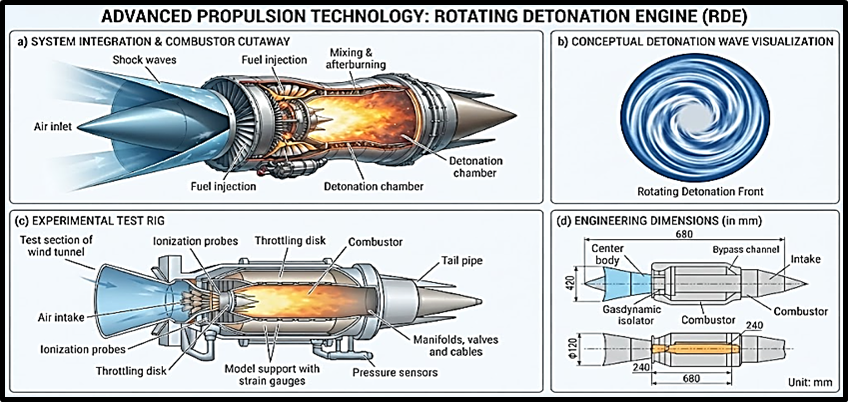
About Rotating Detonation Engine (RDE)
- An RDE is a propulsion system in which one or more supersonic detonation waves rotate continuously inside an annular combustion chamber.
- Unlike conventional combustion systems, where combustion generally causes a pressure loss, an RDE is designed around pressure-gain combustion.
Working Mechanism of Rotating Detonation Engine
The RDE works through a continuous rotating detonation wave inside an annular combustion chamber.
1. Propellant Injection: Fuel and oxidizer are continuously injected into the annular (ring-shaped) combustion chamber.
2. Detonation Initiation: An ignition system initiates a supersonic detonation wave. Unlike a conventional flame, the detonation is driven by a shock wave that rapidly compresses and heats the fresh propellant mixture.
3. Continuous Wave Rotation: The detonation wave travels circumferentially around the annular chamber. As it passes, it consumes the freshly injected fuel-oxidizer mixture.The energy released by combustion helps sustain the detonation wave, allowing it to continue rotating.
4. Pressure Gain: The intense compression associated with the detonation produces high-pressure combustion products. This pressure-gain combustion is the key feature that distinguishes an RDE from conventional pressure-loss combustors.
5. Thrust Generation: The high-pressure, high-temperature combustion products flow toward the exhaust/nozzle and expand, generating thrust.
Advantages and Applications of Rotating Detonation Engine
Advantages
- Higher Thermodynamic Efficiency: Uses pressure-gain combustion, potentially achieving greater efficiency than conventional pressure-loss combustors.
- Compact Design: The annular combustion chamber enables a short and compact engine.
- Few or No Moving Parts: Reduces mechanical complexity and potentially lowers maintenance requirements.
- Continuous Operation: The continuously rotating detonation wave can provide quasi-steady thrust, unlike conventional pulsed detonation systems.
- High Performance-to-Size Ratio: High-pressure detonation in a compact chamber makes RDEs attractive for space- and weight-constrained propulsion systems.
Applications
- Rocket & Spacecraft Propulsion: Potential use in rocket engines, particularly upper-stage and spacecraft propulsion.
- Hypersonic Aircraft & Missiles: Can support high-speed propulsion systems requiring compact, high-performance engines.
- Gas-Turbine Power Generation: Potential application in gas turbines to improve combustion efficiency.
- Ramjet/Scramjet Systems: RDE technology can be integrated with air-breathing propulsion concepts.
- Compact Propulsion Systems: Useful where high efficiency, compactness and reduced mechanical complexity are important.
Key Challenges
- Injection Control: Injecting fuel and oxidizer without disrupting the detonation wave.
- Wave Stability: Maintaining stable single or multiple detonation waves.
- Thermal Loads: Managing extreme heat and pressure through advanced cooling and materials.
- Starting & Nozzle Integration: Establishing self-sustaining detonation and ensuring efficient exhaust flow.
Conclusion
RDE uses pressure-gain combustion for more efficient and compact propulsion. AFRL, NASA and others have successfully tested the technology. However, stability, heat and design challenges mean it is still largely experimental.
| This concept has been elaborately discussed in the following article – Rotating Detonation Engines (RDEs): Next-Generation Propulsion |