
Context
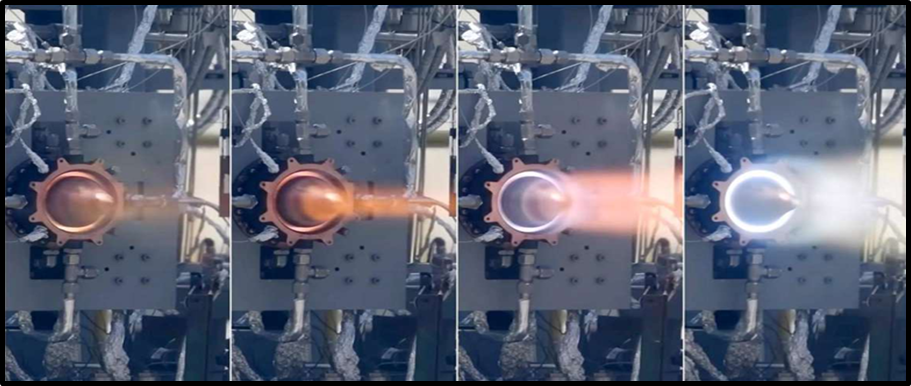
Recently Hyderabad-based defence start-up D-Propulse has successfully demonstrated a Rotating Detonation Engine (RDE) at a DRDO facility, highlighting India’s growing capabilities in advanced propulsion technology.
About Rotating Detonation Engine(RDE)
- Definition :An advanced propulsion system that uses detonation waves for more efficient fuel-energy conversion, with potential applications in rockets, missiles and hypersonic systems.RDE Uses detonation, driven by a supersonic shock wave, instead of conventional combustion.
- Working: The detonation wave continuously rotates through a ring-shaped (annular) chamber, producing sustained thrust.
Key Difference between RDE and Conventional Engines
The key advantage of RDEs is higher thermodynamic efficiency, which can potentially reduce fuel consumption for a given level of output.
Rotating Detonation Engine (RDE) vs Pulsed Detonation Engine(PDE)
- PDE (Pulsed Detonation Engine): Detonation occurs in cycles, with the wave travelling through a tube and restarting after each cycle.
- RDE (Rotating Detonation Engine): Detonation waves continuously rotate within an annular chamber, enabling more continuous thrust.
Why Does It Matter for India?
RDE technology could contribute to the development of more fuel-efficient and high-performance propulsion systems, strengthening India’s capabilities in missile, aerospace and space technologies.
The Major Challenge
The technology requires precise control of fuel injection, pressure and combustion stability, while engine components must withstand extremely high temperatures and pressures
Why is this article important for UPSC?
- Understanding the concept of detonation-based propulsion.
- Awareness of India’s indigenous defence and space start-up ecosystem.
- Knowledge of comparative propulsion technologies helps to understand application-based principles on rocket and missile systems.
In this article, you will understand:
- D-Propulse’s rotating detonation engine demonstration
- Difference between detonation and deflagration
- Pulsed versus Rotating Detonation Engines
| Important CTC from this article for UPSC Rotating Detonation Engines. DRDO |
With reference to Rotating Detonation Engines (RDEs), consider the following statements:
I. An RDE achieves combustion at constant volume, unlike a conventional engine which combusts at constant pressure.
II. In an RDE, the detonation wave travels through an annular combustion chamber in a single, non-repeating pulse.
III. RDEs are reported to offer around 10% to 25% more thermodynamic efficiency than conventional combustors.
Which of the statements given above is/are correct?
(a) I and II only
(b) II and III only
(c) I and III only
(d) I, II and III
Answer: (c). I and III only
Explanation:
Statement I is Correct: In a regular engine, combustion occurs at constant pressure (deflagration). In a detonation engine, the shock wave compresses the mixture before combustion, and the detonation itself happens at constant volume, converting more chemical energy into pressure.
Statement II is Incorrect: An RDE makes detonation a continuous, circulating process — the detonation wave races repeatedly around the annular chamber rather than passing through once. A single, non-repeating pulse through a long tube describes a Pulsed Detonation Engine (PDE), not an RDE.
Statement III is Correct: RDEs are reported to offer around 10% to 25% more thermodynamic efficiency than conventional combustors, which could theoretically translate into significant fuel savings for the same output.