
Important for GS Prelims – Science & Technology
About Accelerator Mass Spectrometry (AMS) Radiocarbon Dating
- Accelerator Mass Spectrometry radiocarbon dating determines the age of organic materials by directly counting Carbon-14 atoms.
- It is based on the 5,730-year half-life of Carbon-14, which gradually decreases after an organism dies compared with stable Carbon-12.
- It can reliably date organic materials up to approximately 50,000–60,000 years, beyond which Carbon-14 is too difficult to detect accurately.
- Unlike methods that measure radioactive decay over days or weeks, it directly counts individual Carbon-14 atoms, making it 1,000 to 10,000 times more sensitive.
Formation and Decay of Carbon-14
- Origin: Cosmic rays convert atmospheric Nitrogen-14 into Carbon-14, which enters living organisms through carbon dioxide, photosynthesis, and the food chain.
- Radioactive Clock: After death, carbon exchange stops and Carbon-14 gradually decays back into Nitrogen-14.
- Isobar Filtering: Nitrogen is naturally excluded during measurement because it does not readily form stable negative ions.
How Measurement Works
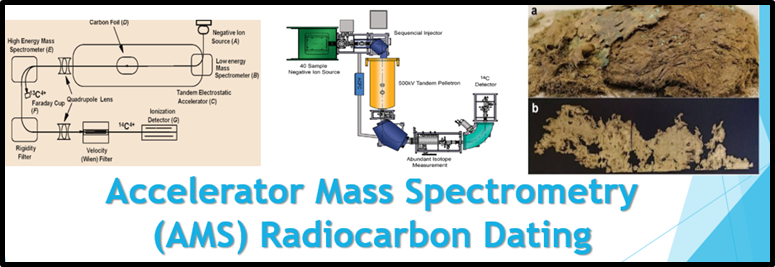
- A caesium beam produces negatively charged carbon ions from prepared graphite.
- These ions are accelerated and stripped of electrons, becoming positive ions while unwanted molecular particles are removed.
- Magnetic and electrostatic fields separate the ions, and individual Carbon-14 atoms are counted.
- Samples are cleaned of contaminants before being converted into graphite.
Advantages and Applications
- Requires only 20–500 milligrams of material, compared with at least 10 grams for conventional methods.
- Results are available within hours to under 24 hours, rather than days or months.
- Used to date archaeological materials such as charcoal, pottery residue, and cave-art pigments, including findings from Keeladi, Tamil Nadu.
- Also supports ocean and ice-core research using Beryllium-10, as well as drug-tracing and metabolic studies.
Calibration and Limitations
- Results must be calibrated into calendar years because atmospheric Carbon-14 levels vary due to solar activity, geomagnetic changes, and human activities such as fossil-fuel combustion.
- Beyond approximately 50,000–60,000 years, or around ten half-lives, remaining Carbon-14 becomes too scarce to measure reliably.
Conclusion
Accelerator Mass Spectrometry radiocarbon dating directly counts Carbon-14 atoms, enabling reliable dating up to 50,000–60,000 years with only milligram-scale samples. Its precision and minimal sample requirement make it widely used in archaeology, palaeoclimatology, and biomedical research.
| This concept has been elaborately discussed in the following article – ● Bakhira Lake Sediments and Water Resource Management in the Central Ganga Plain |