
Important for GS Prelims: Environment
About
- An Eco-Sensitive Area (ESA) is a region of high ecological, environmental, or biological significance declared by the Ministry of Environment, Forest and Climate Change (MoEFCC) to regulate activities that may harm its fragile ecosystem.
- ESAs are declared under the Environment (Protection) Act, 1986 to conserve biodiversity and promote sustainable development.
Objectives
- Conserve ecologically fragile ecosystems and biodiversity.
- Prevent environmental degradation due to unplanned development.
- Regulate land-use changes and polluting activities.
- Promote sustainable development while protecting natural resources.
Key Features
- Restrictions vary depending on the ecological sensitivity of the area.
- Local communities are generally allowed to continue traditional and sustainable livelihood activities.
- Activities are classified as Prohibited, Regulated, or Permitted.
| Major Prohibited Activities | Activities Generally Regulated | Activities Generally Permitted |
| Commercial mining and quarrying. Setting up of highly polluting (Red Category) industries. Major hydroelectric projects (where specifically restricted). Disposal of hazardous waste. Brick kilns and other environmentally damaging activities. | Construction projects. Tourism and eco-tourism. Expansion of roads. Use of groundwater for commercial purposes. Establishment of new industries (depending on notification). | Organic farming. Rainwater harvesting. Traditional agriculture and horticulture. Renewable energy projects with safeguards. Local community livelihood activities. |
Important Eco-Sensitive Areas in India
- Western Ghats ESA
- Bhagirathi Eco-Sensitive Area (Uttarakhand)
- Sawantwadi–Dodamarg Wildlife Corridor ESA (Maharashtra)
Eco-Sensitive Area (ESA) vs Eco-Sensitive Zone (ESZ)
| Eco-Sensitive Area (ESA) | Eco-Sensitive Zone (ESZ) |
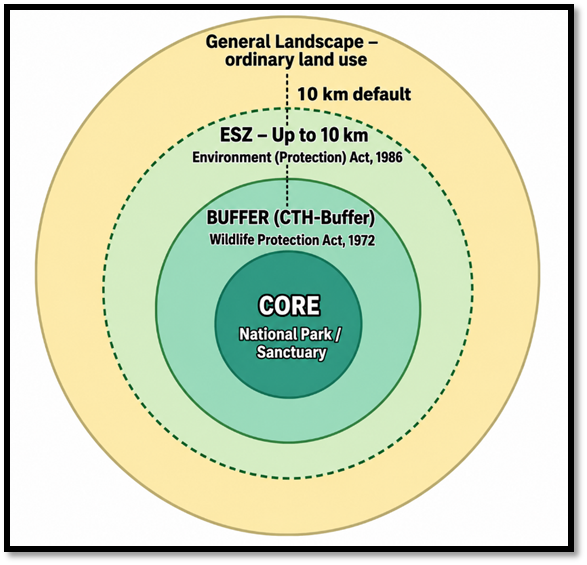
| Large ecologically significant landscape. | Buffer area around National Parks and Wildlife Sanctuaries. |
| Notified under the Environment (Protection) Act, 1986. | Also notified under the Environment (Protection) Act, 1986. |
| May include forests, hills, river basins, wildlife corridors, etc. | Primarily surrounds Protected Areas. |
| Focuses on conserving fragile ecosystems at the landscape level. | Acts as a “shock absorber” and transition zone around Protected Areas. |
Conclusion
Eco-Sensitive Areas provide a legal framework to balance environmental conservation with sustainable development by regulating activities in ecologically fragile landscapes.
| This concept has been elaborately discussed in the following article: Centre Reissues Draft Notification on Western Ghats Eco-Sensitive Area (ESA) |