
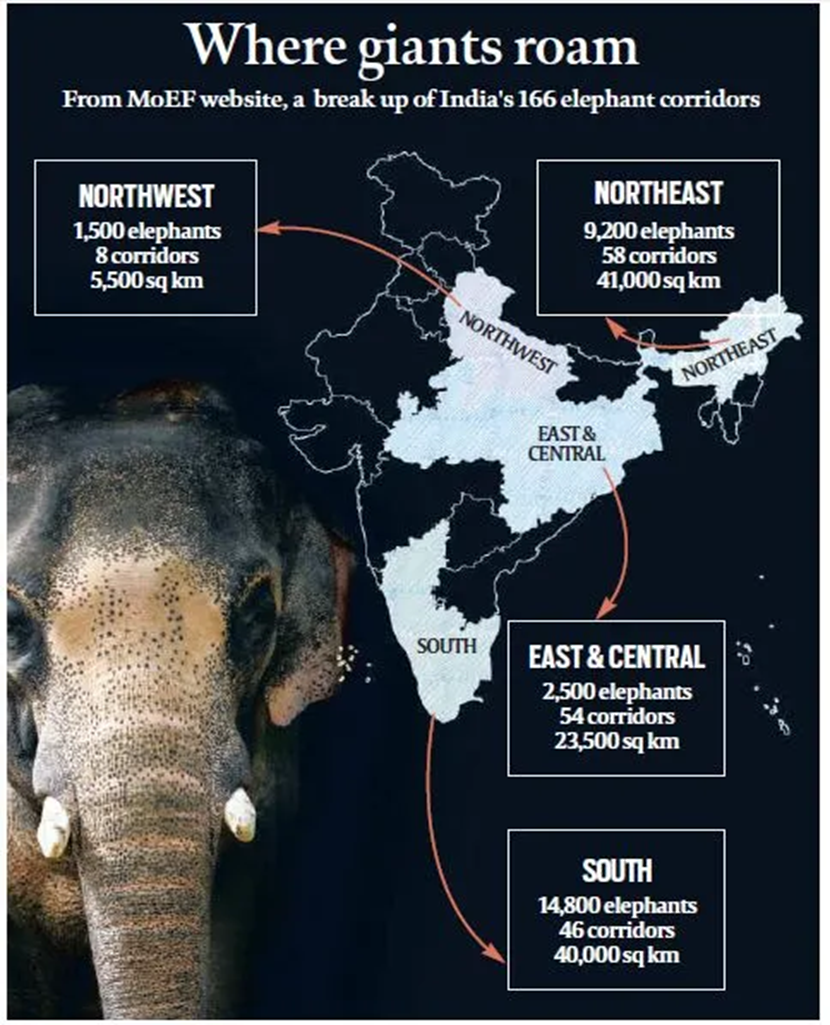
About Elephant Corridor?
- An elephant corridor is a strip of land that facilitates the movement of elephants between two or more viable habitat patches.
- Such corridors support within-home-range movement, seasonal migration and dispersal.
- Importantly, movement of elephants into human-dominated areas without connecting viable habitat patches is not considered an elephant corridor under the 2023 MoEFCC report.
Why are Elephant Corridors Important?
- Ecological Connectivity: Connect fragmented forests and enable elephant movement.
- Genetic Viability: Facilitate gene flow between populations.
- Conflict Reduction: Reduce elephant encounters with villages and farms.
- Ecosystem Functions: Support seed dispersal and forest regeneration.
- Landscape Conservation: Connect habitats across States and human-dominated landscapes.
Elephant Corridors of India – 2023 Report
- The Ministry of Environment, Forest and Climate Change (MoEFCC), in collaboration with State Forest Departments and with technical support from the Wildlife Institute of India (WII), ground-validated 150 elephant corridors across 15 elephant-range States.
Four Elephant-Bearing Regions
| Region | No. of Corridors | Key States |
| East-Central | 52 | Odisha, Jharkhand, Chhattisgarh, West Bengal |
| North-East | 48 | Assam, Arunachal Pradesh, Meghalaya, Nagaland, West Bengal |
| Southern | 32 | Karnataka, Kerala, Tamil Nadu, Andhra Pradesh |
| Northern | 18 | Uttarakhand, Uttar Pradesh, Bihar |
State-wise Elephant Corridors
- West Bengal – 26: Highest number of identified elephant corridors in India.
- Tamil Nadu – 18
- Jharkhand – 17
- Odisha – 14
- Assam – 12
- Uttarakhand – 10
The remaining identified range States have fewer than 10 corridors each.
Major Threats to Elephant Corridors
- Habitat fragmentation: Roads, railways and linear infrastructure.
- Mining & industries: Destruction and disruption of habitats.
- Encroachment: Settlements, resorts and agricultural expansion.
- Physical barriers: Walls, fencing and trenches block movement.
- Land-use change: Conversion of forests for human activities.
- Human–elephant conflict: Blocked routes push elephants into villages and farms.
Legal & Institutional Protection
1. Wild Life (Protection) Act, 1972
- Corridors are not a separate Protected Area category.
- May be protected as Conservation/Community Reserves.
2. Project Elephant, 1992
- Provides technical & financial support for elephant conservation.
- Focus: corridors, habitat and human–elephant conflict.
- MoEFCC + States identify and conserve corridors.
3. Constitutional Provisions
- Article 48A: Protect environment, forests & wildlife.
- Article 51A(g): Duty to protect environment & show compassion to animals.
Conclusion
Elephant corridors are ecological lifelines essential for habitat connectivity and elephant survival. Their protection requires scientific mapping, legal safeguards, inter-State coordination and wildlife-friendly infrastructure to reduce human–elephant conflict and promote coexistence.
| This concept has been discussed in the following article: Supreme Court: No State Can Block Traditional Elephant Routes |