
Context
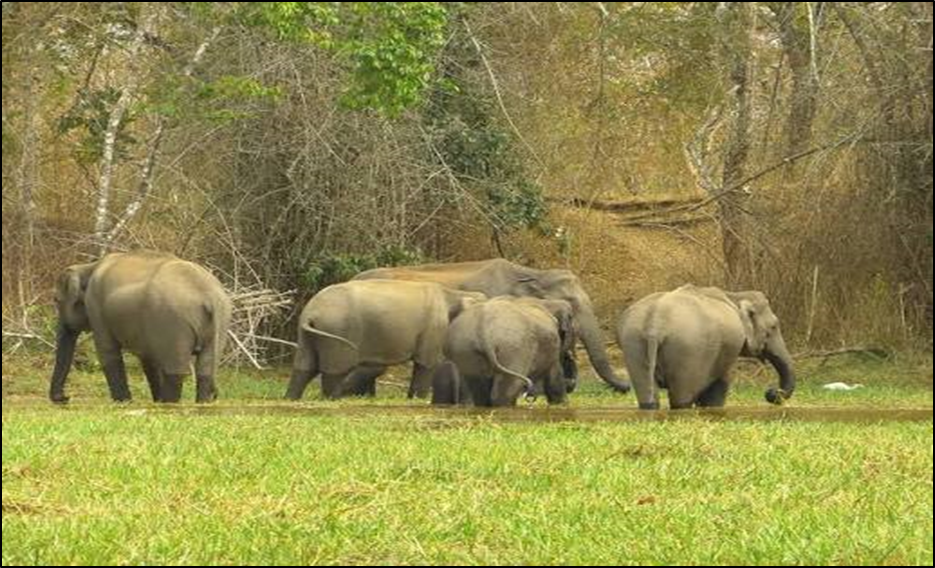
- The Supreme Court has directed the Centre to conduct a fresh nationwide survey of traditional elephant corridors and identify physical barriers obstructing the free movement of wild elephants.
What are Elephant Corridors?
- An elephant corridor is a strip of land that facilitates the movement of elephants between two or more viable habitat patches.
- Corridors are crucial because elephant populations often require large, interconnected landscapes rather than isolated protected areas.
- Maintaining these routes helps reduce habitat fragmentation and human–elephant conflict.
Major Threats to Elephant Corridors
- Infrastructure development such as roads, railways and other linear projects can fragment habitats and disrupt elephant movement. Encroachment and construction, including buildings, resorts and human settlements, can obstruct traditional routes.
- Other major threats include agricultural expansion, fencing and walls, trenches, firebreaks, mining and quarrying, and other land-use changes. The Supreme Court highlighted in particular physical barriers that prevent elephants from using their traditional movement routes.
Elephant Corridors in India:
According to the Elephant Corridors of India 2023 report of the Ministry of Environment, Forest and Climate Change:
- 150 elephant corridors were reported across 15 elephant range States.
- These occur across India’s four elephant-bearing regions.
- Corridors were classified as “active” or “impaired” based on their use by elephants.
- The Gajah report (2010) of the Elephant Task Force had earlier listed 88 elephant corridors.
Elephant Reserve vs Elephant Corridor
| Feature | Elephant Reserve | Elephant Corridor |
| Nature | Larger conservation/management landscape | Movement route between habitat patches |
| Purpose | Long-term elephant conservation | Maintain connectivity and movement |
| Focus | Habitat and population management | Habitat connectivity |
| concern | Conservation of elephant landscapes | Preventing obstruction and fragmentation |
| Important CTC from This Article for UPSC Elephant Corridors in India Project Elephant |
Q. With reference to elephant corridors in India, consider the following statements:
1. Elephant corridors facilitate movement between two or more viable habitat patches.
2. Elephant corridors are synonymous with Elephant Reserves notified under Project Elephant.
3. Habitat fragmentation and physical barriers can impair elephant corridors.
4. The Indian Elephant is listed under Schedule I of the Wild Life (Protection) Act, 1972.
Which of the statements given above are correct?
(a) 1 and 2 only
(b) 1, 3 and 4 only
(c) 2, 3 and 4 only
(d) 1, 2, 3 and 4
Answer: (b) 1, 3 and 4 only
• Statement 1 – Correct: Corridors connect two or more viable habitat patches.
• Statement 2 – Incorrect: Elephant Corridors and Elephant Reserves are distinct concepts; a corridor is primarily a movement pathway.
• Statement 3 – Correct: Infrastructure, construction and other physical barriers can fragment or obstruct corridors.
• Statement 4 – Correct: Elephas maximus is included in Schedule I of the Wildlife (Protection) Act, 1972.