
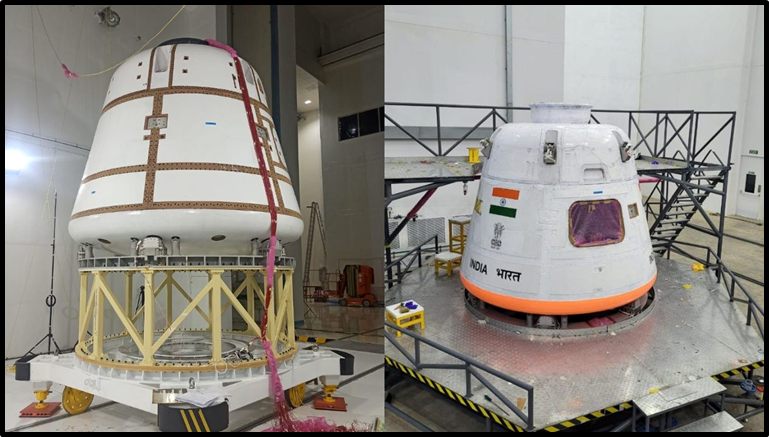
About the Thermal Protection System
- Definition: A specialized, high-performance external shielding layer engineered to protect a spacecraft, space shuttle, or crew capsule from extreme aerodynamic heating during high-speed atmospheric ascent and hypersonic re-entry.
- Developed by: the Indian Space Research Organisation (ISRO), as part of the Gaganyaan human spaceflight programme.
- Type: an ablative (sacrificial, single-use) thermal protection system, applied on the Gaganyaan Crew Module.
- Technological heritage: built upon indigenous ablative technologies validated through ISRO’s Space Capsule Recovery Experiment (SRE) and the LVM3 / CARE (Crew Module Atmospheric Re-entry Experiment, 2014) missions.
Why a Thermal Shield is Essential
- When the capsule returns from Low Earth Orbit (LEO) at hypersonic velocities, over 99% of its kinetic energy transforms into intense shock-layer heating, creating plasma fields that reach up to 1,800°C.
- Unlike the ascent phase, the descent stage cannot be aborted once initiated, making the re-entry phase entirely irreversible.
- Deceleration happens at extreme speeds that outpace any human ability to react manually, necessitating a completely passive, independent, and foolproof thermal defense.
- The shielding layer ensures that both the astronauts’ living space and the underlying structure—constructed from carbon fiber reinforced polymer (CFRP) or aluminum alloy—remain safely within tolerance thresholds.
Mechanics of Ablative Thermal Defence
- Subjected to brutal aerodynamic friction, the binder resin inside the ablative material absorbs thermal energy and undergoes an endothermic chemical process known as pyrolysis.
- As the outer strata burn away, they transform into a porous carbon char layer that protects the unburnt material underneath while sacrificing mass to carry heat away.
- Gases generated during pyrolysis escape outward, pushing the scorching shock-wave plasma boundary away from the capsule’s outer shell to block incoming convective heat.
Core Architecture and Specifications
- Despite confronting external heat levels of 1,800°C, the protective shield maintains a compact thickness of just 30 to 35 mm, successfully keeping underlying structural components below 150°C.
- The layout employs a two-material structure where the nose section relies on high-density carbon phenolic tiles to handle maximum heat concentration and stagnation pressures, whereas the side panels and afterbody utilize medium-density silica phenolic ablators to manage turbulent wake-flow heating.
- Opting for a sturdy, impact-resistant single-use composite instead of fragile ceramic radiative tiles—which are prone to cracking and demand expensive post-flight maintenance—ensures a reliable, time-tested framework.
Conclusion
Gaganyaan’s Thermal Protection System is crucial for safely bringing astronauts back to Earth after spaceflight.Built on ISRO’s proven experience, it reflects India’s growing ability to develop safe, reliable and indigenous human-spaceflight technologies.
| This concept has been elaborately discussed in the following article – Gaganyaan’s Ablative Heat Shield: Protecting Astronauts During Re-entry |