
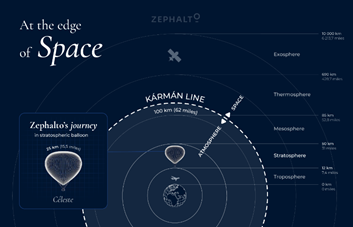
About the Karman Line
- Definition and Location: It is an imaginary boundary situated exactly 100 km (62 miles) above sea level that separates Earth’s atmosphere from outer space.
- Historical Origin: It was officially established in the 1960s by the Fédération Aéronautique Internationale (FAI), the global record-keeping body for aeronautics.
- Nomenclature: The boundary is named in honor of the renowned aerospace pioneer, Theodore von Kármán.
- Varying Standards: While recognised by most global space organisations, entities like NASA, the FAA, and the U.S. military place the edge of space slightly lower, at 80 km (50 miles).
Physical Characteristics and Aviation Limits
- Aerodynamic Shift: It roughly marks the critical altitude where the air becomes too thin to generate aerodynamic lift, preventing traditional aircraft from flying.
- Propulsion Requirement: Any craft traveling beyond this boundary requires a dedicated propulsion system that does not rely on Earth’s atmosphere.
- Environmental Continuity: Despite being a boundary, there is no sudden or drastic change in air pressure, atmospheric composition, or gravitational pull immediately across this line.
- Atmospheric Extension: The Earth’s atmosphere does not abruptly end at this 100 km mark; it gradually thins out into the vacuum of space.
Conclusion
The Karman Line remains a fundamental demarcation for global aerospace governance and international law. Establishing this definitive boundary ensures the peaceful, scientific exploration of outer space while effectively safeguarding the sovereign airspace of individual nations.
| This Concept Has Been Mentioned In The Article: Selection and Training of Astronauts for Spaceflight |