
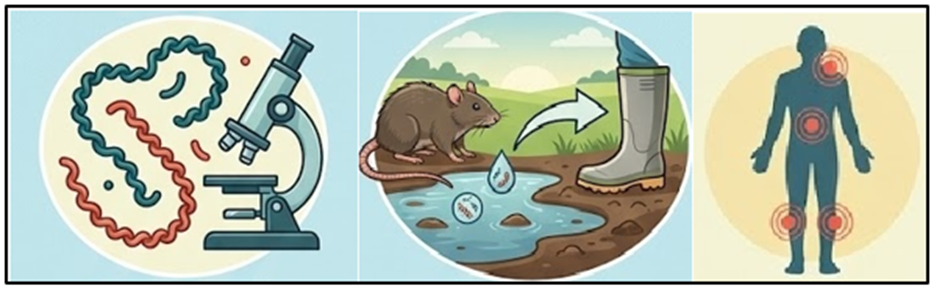
Important for GS Prelims — Science & Technology
About Leptospirosis
- Definition: A zoonotic bacterial disease caused by Leptospira (spirochete), transmitted mainly through water or soil contaminated with the urine of infected animals.
- Vectors/Reservoirs: Rats (major), cattle, dogs, pigs, and other mammals.
- The zoonotic bacteria enter through cuts, mucous membranes, or contaminated water; direct animal-to-human transmission is rare.
Key Facts
| Parameter | Detail |
| Causative agent | Pathogenic species of the genus Leptospira |
| Mode of transmission | Contact with soil/water contaminated with infected-animal urine |
| Incubation period | Average 5-14 days (range 2-30 days) |
| Global burden (WHO estimate) | Approx. 1.03 million cases and 58,900 deaths annually |
| Endemic Indian states | Kerala, Gujarat, Karnataka, Maharashtra, Tamil Nadu |
| Peak season | Monsoon and post-monsoon months |
Clinical Features & Risk Factors
- Milder (anicteric) form: remittent fever, headache, chills, myalgia, and conjunctival suffusion
- Severe (icteric) form / Weil’s disease: jaundice, acute renal failure, haemorrhagic manifestations, and cardiac arrhythmias
- Renal involvement is near-universal, presenting as acute tubular necrosis and interstitial nephritis with cola-coloured urine
- High-risk groups: farmers, sewage/sanitation workers, fishermen, veterinarians, and flood-affected populations
- Common carrier animals: rats, cattle, buffalo, goats, sheep, and dogs
- Diagnosis relies on the Microscopic Agglutination Test (MAT) and ELISA for IgM antibody detection
Important Points
- It is covered under the National Centre for Disease Control (NCDC)’s Programme for Prevention and Control of Leptospirosis
- Monitored nationally through the Integrated Disease Surveillance Programme (IDSP)
- Standard treatment protocol: Benzathine Penicillin for confirmed cases; Doxycycline or Erythromycin for milder/hyper-reactive cases
- State-level responses, notably in Kerala, include monsoon-season Doxycycline prophylaxis for high-risk groups
Conclusion
Leptospirosis remains an under-reported, monsoon-linked zoonotic disease in India, with surveillance and controlled by the NCDC and state health departments under the Integrated Disease Surveillance Programme.
| This concept has been elaborately discussed in the following article – Reason for Rise in Zoonotic Disease Leptospirosis in Kerala |