
Important for GS Prelims – Economy
Introduction
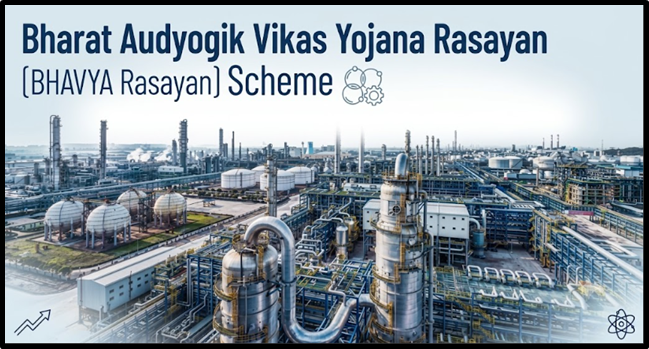
BHAVYA is a landmark centrally sponsored scheme aimed at building plug-and-play, world-class industrial parks across India, enabling domestic and global companies to move straight from “intent to production” — without delays over land acquisition, utility setup, or regulatory clearances.
How the BHAVYA Schemes Work
1. Umbrella BHAVYA Scheme Specifications
- Nodal & Implementing Bodies: DPIIT (Ministry of Commerce & Industry) is the nodal body; implementation is handled by the National Industrial Corridor Development Corporation (NICDC).
- Park Sizes & Location: Parks span 100–1,000 acres (minimum 25 acres in hilly/North-Eastern regions) across all States and UTs.
- Financial & Connectivity Support: Up to ₹1 crore/acre for core, value-added, and social infrastructure, plus external connectivity support covering up to 25% of project cost.
- Challenge-Based Selection: Sites are chosen via a competitive challenge process to promote investment-ready land and cooperative federalism.
- Sustainable Operations: Parks use green energy and a no-dig underground utility model, aligned with PM GatiShakti for seamless multimodal connectivity.
2. BHAVYA-Rasayan Sub-Scheme Specifications
- Budget Split: Of the ₹3,030-crore outlay, ₹3,000 crore funds common infrastructure and basic utilities, while ₹30 crore covers administrative expenses.
- Federal Cost Sharing: The Centre grants up to ₹1,000 crore per park, contingent on a minimum ₹500-crore contribution from the state government.
- Land & Bidding Criteria: States bid via a challenge route, with each selected park requiring at least 8 sq. km (~2,000 acres) of contiguous, encumbrance-free land.
- Centralized Shared Utilities: Plug-and-play shared infrastructure — CETPs, TSDFs, solvent recovery, steam networks, and interconnected pipelines — is expected to cut operational costs by 20–30%.
Paving the Way for Viksit Bharat:
- Boosting Self-Reliance: BHAVYA aims to raise local production of intermediates, battery, and speciality chemicals, targeting zero deficit by 2030.
- Deepening GVC Integration: Cluster-based manufacturing positions India as a strong alternative, aiming to grow its global chemical value-chain share.
- Easing Business Operations: Pre-cleared approvals (60-day single-window clearance) and ready infrastructure enable fast production start, skipping years of land and licensing delays.
- Driving Downstream Growth: Chemical park growth benefits industries like agriculture, pharma, textiles, electronics, construction, and automobiles.
- Attracting Investment & Jobs: The three parks could draw ₹20,000–50,000 crore each in private investment, with the wider plan targeting 7–10 lakh new jobs by 2030.
Conclusion
BHAVYA marks a strategic shift toward plug-and-play industrial infrastructure, positioning India as a globally competitive manufacturing hub while advancing self-reliance in critical sectors like chemicals. By easing entry barriers and driving investment, jobs, and downstream growth, it lays a strong foundation for India’s Viksit Bharat @ 2047 vision.
| This article has been elaborately discussed in Bharat Aatmanirbhar Vigyan Yojana (BHAVYA) – Chemical Parks Scheme |