
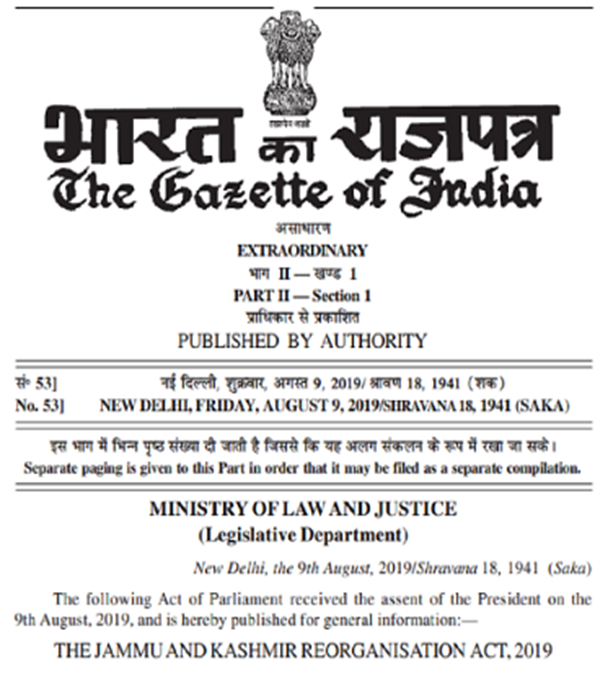
About the Jammu and Kashmir Reorganisation Act, 2019
- The Jammu and Kashmir Reorganisation Act, 2019 was enacted by Parliament to reorganise the erstwhile State of Jammu and Kashmir into two Union Territories.
- The Act was passed by Parliament on 5–6 August 2019, received the President’s assent on 9 August 2019, and came into force on 31 October 2019.
- It was enacted following the constitutional changes relating to Article 370 through the Constitution (Application to Jammu and Kashmir) Order, 2019.
- The Act provides for the reorganisation of the territory, governance, legislature, judiciary, public services and representation in Parliament.
Key Features of the Act
I. Creation of Two Union Territories
- Union Territory of Jammu and Kashmir (with a Legislative Assembly).
- Union Territory of Ladakh (without a Legislative Assembly).
II. Legislative Assembly
For the Union Territory of Jammu and Kashmir:
- A Legislative Assembly is provided on the lines of the Union Territory of Delhi.
- The Assembly can legislate on subjects in the State List and Concurrent List, except Public Order and Police, which remain under the Union Government.
- The Lieutenant Governor (LG) is the Administrator of the Union Territory.
III. Union Territory of Ladakh
- Ladakh functions as a Union Territory without a Legislature.
- It is administered directly by the Lieutenant Governor appointed by the President.
- The Ladakh Autonomous Hill Development Councils (LAHDCs) of Leh and Kargil continue to function under existing laws.
IV. High Court
- The existing High Court of Jammu and Kashmir became the High Court of Jammu & Kashmir and Ladakh.
- It continues to exercise jurisdiction over both Union Territories.
V. Representation in Parliament
- The Union Territory of Jammu and Kashmir elects members to both the Lok Sabha and the Rajya Sabha.
- The Union Territory of Ladakh is represented in the Lok Sabha, but it does not have representation in the Rajya Sabha.
VI. Delimitation of Constituencies
- The Act provided for the delimitation of Assembly constituencies in Jammu & Kashmir.
- The Delimitation Commission (2020–2022) redrew Assembly constituencies based on the provisions of the Act.
VI. Constitutional Basis
- Article 3 empowers Parliament to form new States and alter the areas, boundaries or names of existing States.
- Article 239 provides that every Union Territory shall be administered by the President through an Administrator (Lieutenant Governor).
- The Act came into effect after the constitutional changes relating to Article 370.
VII. Difference Between the Two Union Territories
| Union Territory | Legislature | Administrator |
| Jammu & Kashmir | Yes | Lieutenant Governor |
| Ladakh | No | Lieutenant Governor |
Conclusion
The Jammu and Kashmir Reorganisation Act, 2019 marks a significant constitutional and administrative reform by reorganising the erstwhile State into two Union Territories. It redefined the governance structure, legislative framework and administrative arrangements of the region while remaining an important topic for Indian Polity and UPSC Prelims.
| This concept has been elaborately discussed in the following article – Prime Minister marks seven years of the abrogation of Articles 370 and 35(A). |